Presentation on November 6, 2026 8:00 pm PST
in the CSM Planetarium
Speaker: Dr. Phil Marshall
Stanford/SLAC
Welcome to the Vera C. Rubin Observatory
Free and open to the public. Free parking in nearby lots. Details at bottom of page.
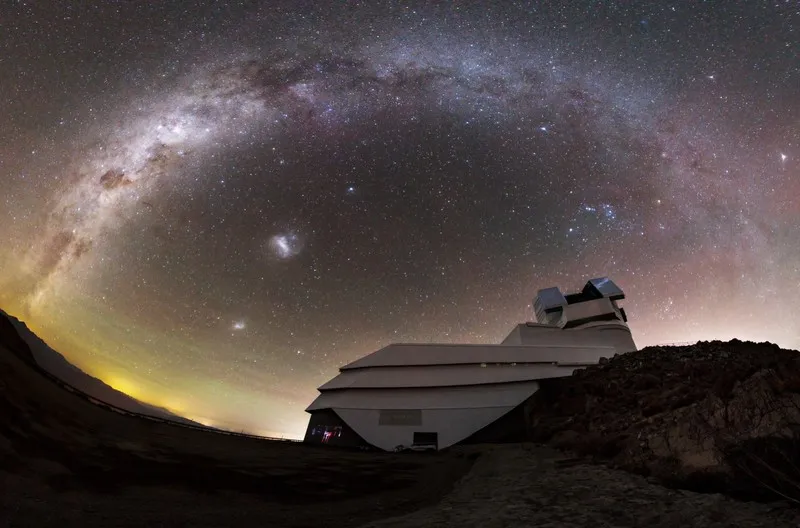
A couple of decades in the making, the NSF-DOE Vera C. Rubin Observatory (Rubin) is the world’s newest and fastest astronomy and astrophysics facility. Located in Chile, its primary mission is to conduct an astronomical survey of the southern sky every few nights, creating a ten-year time-lapse record, the Legacy Survey of Space and Time (LSST), the most comprehensive, cinematic record of the Universe in history.
The LSST will be an unprecedented astronomical data set for studies of the deep and dynamic universe. It is designed to be for everyone: Rubin will make the data widely accessible to a diverse community of scientists and use it to enable the public to explore the Universe to greater depth and in more detail than ever before.
The LSST Camera, built at SLAC and now mounted on Rubin’s Simonyi Survey Telescope, presents everyone with a Big Data problem: how to cope with more astronomical data than has been taken by all previous telescopes combined, being accumulated and presented at unprecedented speed? Part of the answer to this question is “AI” – but what will that mean, in practice? Come and think big in the CSM Planetarium.
Join Rubin’s Deputy Director of Operations, Phil Marshall, for a virtual tour of the Observatory in Chile and hear more about Rubin and its mission.

Phil is currently Deputy Director of Operations at the Rubin Observatory, setting up the Rubin Observatory and its survey to successfully deliver the data products needed by, for example, the cosmology analysis planned by the LSST Dark Energy Science Collaboration (DESC). He helped form the LSST DESC at its inaugural meeting in 2012, and held leadership positions in it for 7 years until he moved to his current position at Rubin. Phil was LSST DESC Spokesperson in 2017-2019, during which time he led the implementation of the collaboration’s operations plan. His long-running scientific interest is strong gravitational lenses, whose Einstein rings and time delays can be used to probe the accelerated expansion history of the Universe, and which can help us probe the nature of Dark Matter via the sub-galactic structure than perturbs the lensing effect. Analyzing tens of thousands of these systems from the LSST will take new approaches to lens detection and modeling: Phil and his group at KIPAC are investigating machine learning with deep neural networks as a way to carry out principled, multi-level scientific inference at LSST scale. Phil did his PhD on Bayesian Analysis of Clusters of Galaxies at the University of Cambridge, in which he first got interested in the process of measuring astronomical objects, including things like Dark Matter halos which we may not be able to observe directly. He first moved to Stanford in 2003 as one of KIPAC’s first wave of postdocs, and returned as Kavli Fellow in 2009 after three years as TABASGO Fellow at the University of California, Santa Barbara. Phil then spent three years in Oxford as a Royal Society University Research Fellow, before moving back to join the SLAC staff on a permanent basis in 2013.
The NSF–DOE Vera C. Rubin Observatory, funded by the U.S. National Science Foundation and the U.S. Department of Energy’s Office of Science, will perform the Legacy Survey of Space and Time using the LSST Camera and the Simonyi Survey Telescope. Rubin Observatory is a joint Program of NSF NOIRLab and DOE’s SLAC National Accelerator Laboratory.
Venue Details
The San Mateo County Astronomical Society Star Parties, Speaker Series, and meetings are free and open to the public. Free parking in nearby lighted parking lots, easy access to the Planetarium. Speaker Series and meetings happen in person at the College of San Mateo Planetarium. General meetings and socials start at 7:00 pm in Room 110 in the ISC Building (36). Speaker presentations start at 8:00 pm in the Planetarium. Although generally not a problem in CSM’s state-of-the-art, 77 seat Planetarium, plan to arrive early to assure entry, as seats are first-come, first-served, not reserved. Please note that all guests must be seated and there will be no standing allowed due to safety concerns, access into the Planetarium is stopped once the seats are full.