
By Sanah Ayyar
SMCAS Member
Disclaimer:
These are the musings of a high schooler, probably with black holes all over them. No peer review, no formal proofs, just tons of curiosity. I’d love corrections and ideas from mathematicians and astronomers and knowledgeable readers.
As I tackle advanced multivariable calculus in high school this year, I can’t help noticing how studying Calculus has given me a fresh perspective on the world around me. Things just seem to make more sense.
During last month’s star party at Crestview Park, while drooling over the amazing constellation and nebula pictures captured by the telescopes, I started wondering : what is the connection between constellations and calculus?
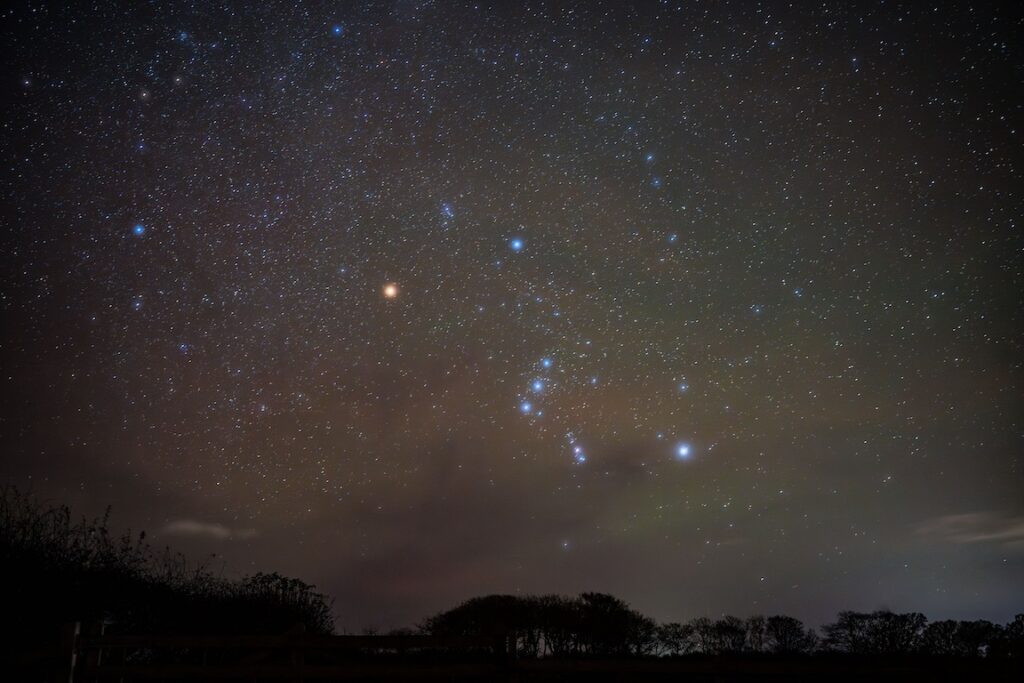
I have always found it strange that we give shapes to stars. Look up at the night sky and you might see Orion, the Big Dipper, or Cassiopeia. But the stars themselves aren’t actually connected. We draw imaginary lines between them and decide that a collection of distant points looks like a hunter, a bear, or a queen.
At first, the idea of calculus in constellation shapes seems ridiculous. Calculus is about limits, derivatives, integrals, and rates of change. Constellations are just patterns of stars. What could they possibly have in common?
Then I thought about what we actually do when we draw a constellation.
We start with points. Mathematically, we can assign coordinates to those stars. One star might be at (2,3), another at (6,11). If we connect them, we have created a line. And once we have a line, we can ask a very simple mathematical question.
How steep is the line? m = (y2 – y1)/(x2 – x1)
If you’re not familiar with this equation, it is also interpreted as rise over run, where the top half tells us how much the line rises, while the bottom half tells us how much it runs as we move across it.
Suddenly, my constellation isn’t just a picture anymore. It is a collection of coordinates and line segments.
And then I realized something even more interesting.
What if the constellation isn’t made of straight lines?
What if we tried to draw a smooth curve through several stars?
Now we could ask questions about how the curve changes from one point to another. Is it getting steeper? Is it flattening out? Where does its direction change?
Those are calculus questions! The derivative, after all, tells us about the instantaneous rate of change (the slope of a curve at a particular point).
So perhaps a constellation could become a kind of mathematical playground. Each star could represent a point. Each line between stars could have a slope. A collection of segments could form a piecewise function. A smooth curve could have a derivative.
The more I thought about it, the more I realized that this wasn’t really about proving that constellations “are” calculus. They aren’t. Orion isn’t secretly an equation written across the sky.
The human brain sees patterns everywhere. We connect stars that may be hundreds of light-years apart and turn them into recognizable shapes.
That realization added a serious plot twist.
The constellation we see from Earth isn’t necessarily what the stars actually look like in space. Two stars that appear next to each other in the sky may be separated by enormous distances. Our two-dimensional picture is really a projection of a three-dimensional arrangement. A constellation could change shape from a different viewpoint.
Now we are dealing with more than just x and y. We need three-dimensional coordinates: (x, y, z).
It reminded me of Carl Sagan’s wonderful explanation of the fourth dimension. We understand two dimensions very well and three dimensions decently well. The fourth is a guess, and beyond that, our brains can’t begin to imagine the possibilities.
With constellations, I think we are in 3D territory, given my limited knowledge about calculus or space. Who knows what else these patterns are hiding? One thing is for sure: this is multivariable calculus and I’d better get back to doing my homework if I ever want to understand all this better.