
By Sanah Ayyar
SMCAS Member
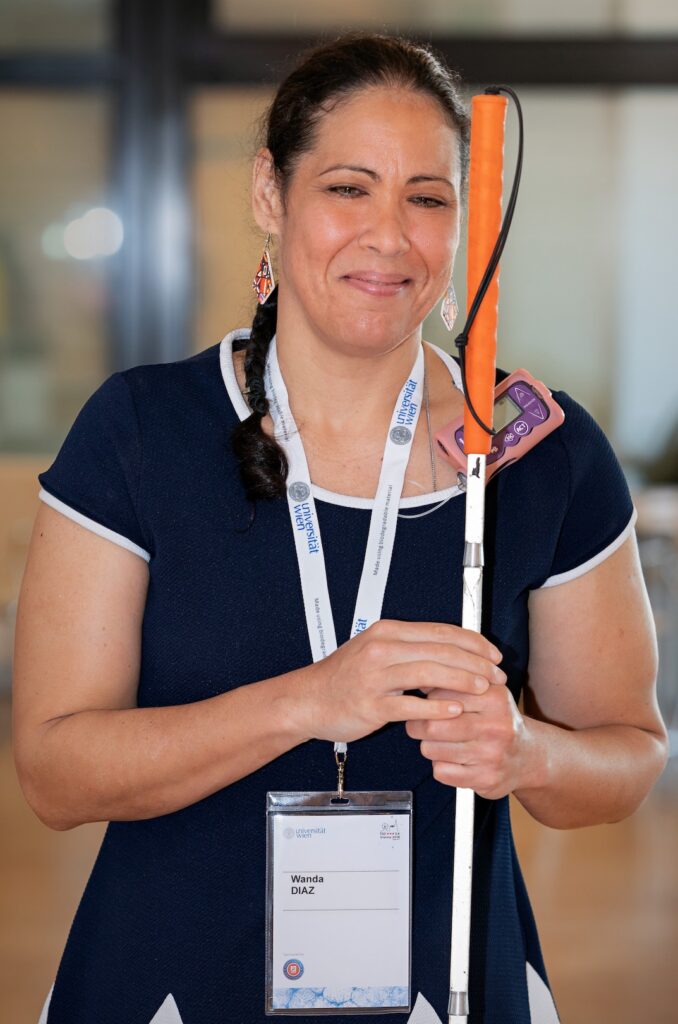
Wanda Diaz-Merced is an astronomer focusing on studying radiation from stars and other celestial objects. However, she is best known for her work in sonification — or the conversion of visual data to audio with differences in pitch, duration, volume, and other auditory qualities.
Her connection with sonification is incredibly personal. Diaz-Merced began to lose her vision in adolescence, peaking at a time around her undergraduate studies. Unable to participate fully in science due to its heavy reliance on sight, she struggled in getting her physics degree. Despite this, she retook the classes until she passed, graduating with her degree after six years.
Her interest in astronomy sparked when her friend showed her a recording of audio created using data from a solar flare. This led to a determination to make astronomy—and science—accessible for everyone, not just those with good vision. She went on to get her PhD in computer science.
To find how viable the use of audio in data analysis was, Diaz-Merced presented astronomers with data from a black hole in visual format, audio format, and both. Her findings indicated that astronomers were better able to detect patterns and variance with the presence of audio format.
Despite the positive result, she was disheartened, saying, “I felt really disappointed at that moment, because people like me had been completely left out of the field for no reason,” referring to the initial rise and subsequent abandonment of sonification in data analysis. But it didn’t stop her, with the realization that “the future was in my own hands, it was the moment to use my results to equalize participation in the field” (Diaz-Merced).
Since then, she has taken up positions at the Harvard Smithsonian Center for Astrophysics, and the South African Astronomical Observatory, and is a prominent figure in the advocacy for sonification in astronomy. She co-chaired the 2019 Astronomy for Equity, Diversity, and Inclusion conference at the National Astronomical Observatory of Japan and has won a few awards for her work.
Since learning about her life and work, she’s become my favorite astronomer and someone I look up to, as an aspiring astronomer who also has vision problems. The work she’s done in making astronomy and its data more widely accessible to the visually impaired has inspired me, as well as her story about persisting through hardship.
Works Consulted
Wanda Díaz-Merced | the Schools’ Observatory. www.schoolsobservatory.org/careers/interested/computers/wanda-d%C3%ADaz-merced
Wanda Díaz-Merced – Scientists With Disabilities | Royal Society. royalsociety.org/about-us/who-we-are/diversity-inclusion/case-studies/scientists-with-disabilities/wanda-diaz-merced