Presentation on May 1, 8:00 pm PST
in the CSM Planetarium
Speaker: Prof. Brian Lantz, Stanford
Exploring the Gravitational Wave Universe with LIGO
Free and open to the public. Free parking in nearby lots.
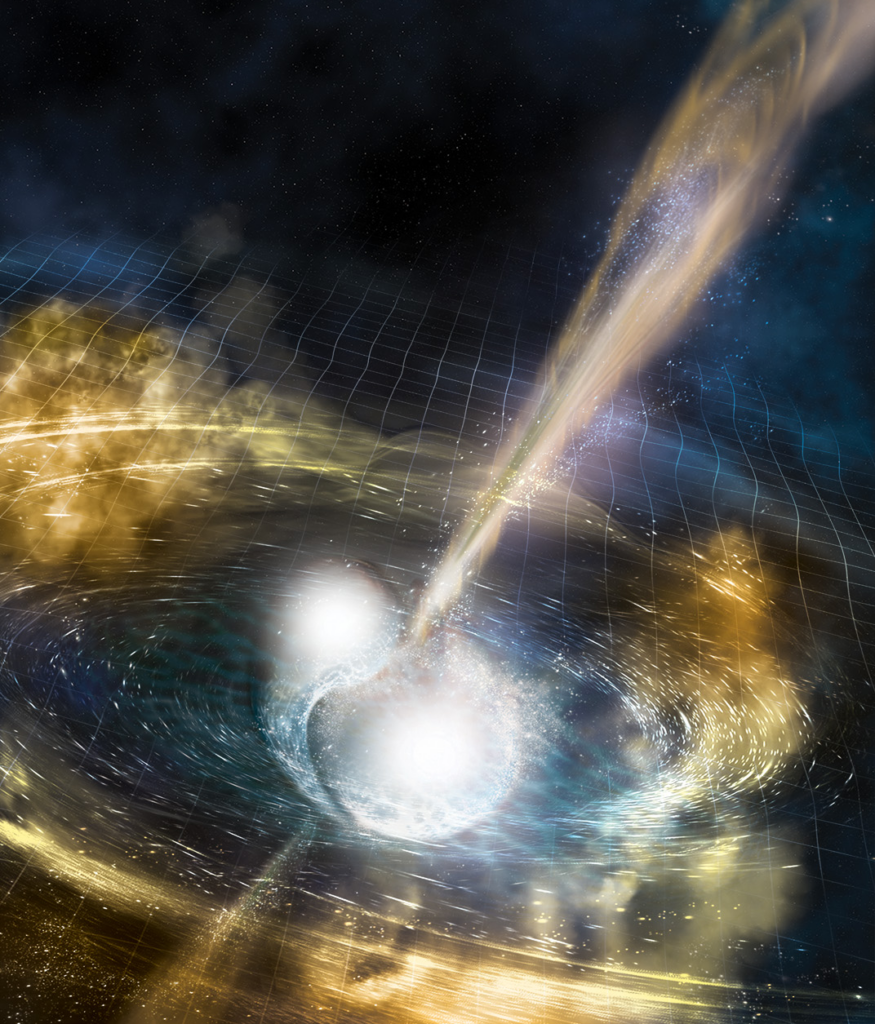
Measuring gravitational waves is a revolutionary new way to do astronomy. In 2015, LIGO (the Laser Interferometer Gravitational-wave Observatory) first detected one of these waves – a tiny ripple in space itself, generated by the collision of 2 black holes. Since then the cumulative number of detections that LIGO and its international partners have measured has exceeded 300, marking a transition from detecting rare events to daily detections. What can we learn from the mergers of black holes or the collision of two neutron stars? How is it possible to measure a wave which stretches our detector 1000 times less than the diameter of a proton? What’s coming next in our search for these tell-tale ripples in space, and what can we learn from these observations that could address a variety of questions such as how black holes form from the collapse of massive stars, the cosmological evolution of the universe and confirming the theory of general relativity? In this presentation, Prof Brian Lantz will cover the emerging astronomy of gravitational wave detection.
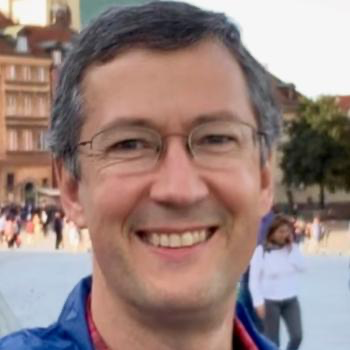
Prof. Brian Lantz is a Research Professor of Applied Physics at Stanford University. He started working on LIGO in 1991 as an undergraduate in Rai Weiss’s lab at MIT and continued there for his Ph.D, building high-power interferometers to prototype LIGO. Prof. Lantz is the scientific leader for the Advanced LIGO seismic isolation system, and he is designing new mirror suspensions to upgrade Advanced LIGO because he loves to work on these amazing machines!
We propose a mission concept for a space observatory with a large-aperture (50-meter) unsegmented primary mirror suitable for a variety of astronomical applications. The mirror would be created in space via a novel approach based on fluidic shaping in microgravity, which has already been successfully demonstrated in a laboratory neutral buoyancy environment, in parabolic microgravity flights, and aboard the International Space Station (ISS). Theoretically scale-invariant, this technique has produced optical components with superb, sub-nanometer (RMS) surface quality.
The San Mateo County Astronomical Society Star Parties, Speaker Series, and meetings are free and open to the public. Free parking in nearby lighted parking lots, easy access to the Planetarium. Speaker Series and meetings happen in person at the College of San Mateo Planetarium. General meetings and socials start at 7:00 pm in Room 110 in the ISC Building (36). Speaker presentations start at 8:00 pm in the Planetarium. Although generally not a problem in CSM’s state-of-the-art, 94 seat Planetarium, plan to arrive early to assure entry, as seats are first-come, first-served, not reserved. Please note that all guests must be seated and there will be no standing allowed due to safety concerns, access into the Planetarium is stopped once the seats are full.