
One of the great things about astronomy is that even our most trusted tools occasionally look back at us and say, “Are you sure about that?” This month’s example comes from one of the biggest ideas in modern cosmology: dark energy, the mysterious something-or-other that appears to be causing the expansion of the universe to accelerate. That discovery, made in the late 1990s using Type Ia supernovae, earned the 2011 Nobel Prize in Physics for Saul Perlmutter, Brian Schmidt, and Adam Riess. Not bad for watching stars explode very, very far away.
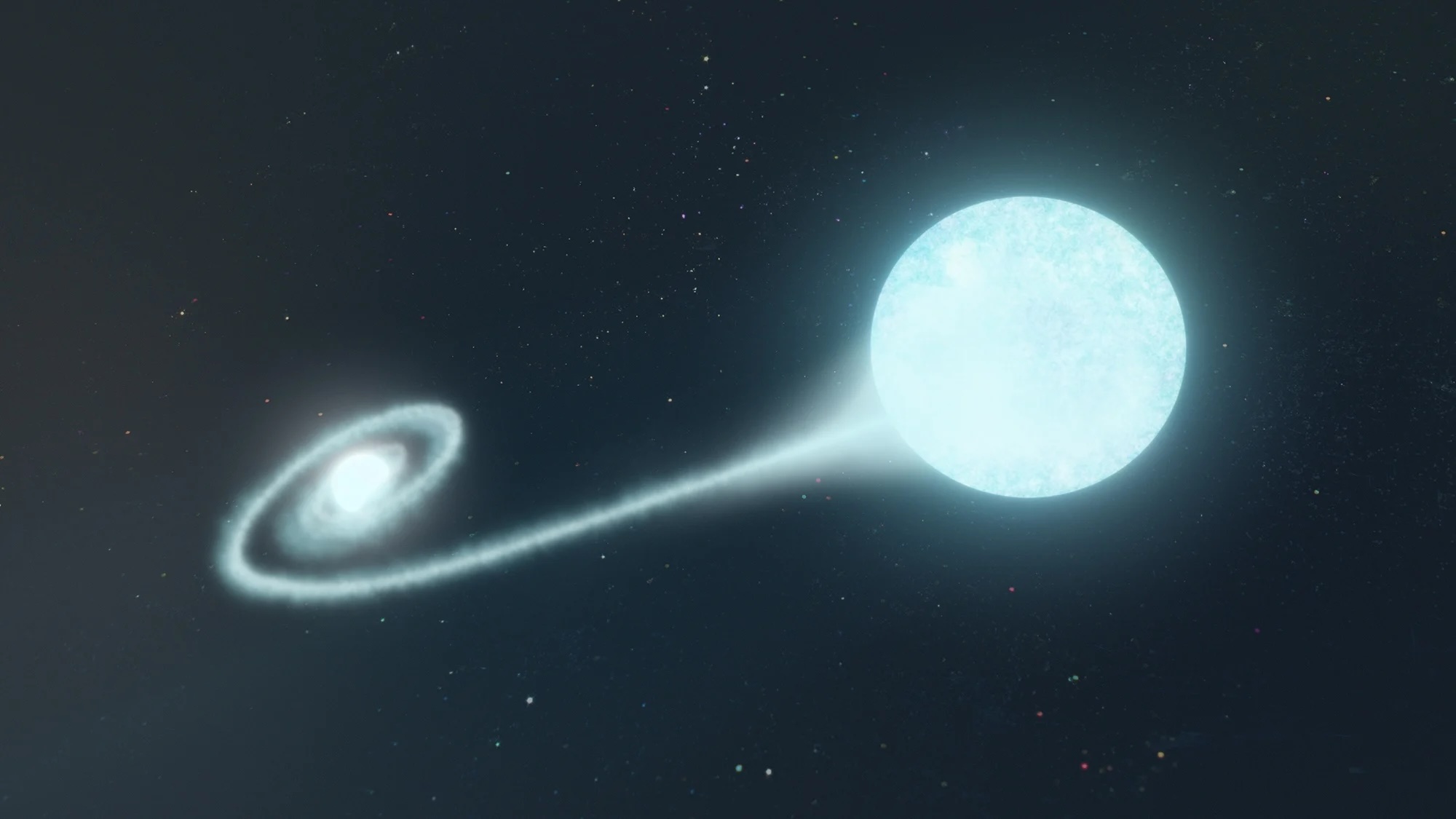
The basic idea is elegant. A Type Ia supernova happens when a white dwarf star in a binary system reaches a critical condition and undergoes a catastrophic thermonuclear explosion. Because these explosions tend to reach similar peak brightnesses, astronomers have long used them as “standard candles.” If you know how bright something really is, and you measure how bright it looks from Earth, you can calculate its distance. A nearby supernova looks bright; a distant one looks faint. Simple enough—at least until the universe starts grading on a curve.
In reality, Type Ia supernovae are not perfect standard candles. They are better described as standardizable candles. Astronomers correct for known differences, such as the shape of the supernova’s light curve: brighter Type Ia supernovae tend to fade more slowly, while dimmer ones fade faster. This relationship, along with color corrections, allows astronomers to bring these stellar explosions onto a more consistent scale.
But there is a growing debate over whether one important correction has been overlooked or underestimated: the age of the stellar population that produced the supernova.
A recent paper, Strong progenitor age bias in supernova cosmology. I. Robust and ubiquitous evidence from a larger sample of host galaxies in a broader redshift range, argues that Type Ia supernova brightness after standardization is still correlated with the age of the host galaxy’s stellar population. The authors write that “post-standardization SN Ia luminosity varies with progenitor age,” and they argue that this is “currently not properly accounted for in SN cosmology.” In plain English: even after astronomers make the usual corrections, supernovae from older stellar environments may not behave exactly like those from younger ones.
Why does this matter? Because looking farther into space also means looking farther back in time. A galaxy whose light has taken billions of years to reach us is being seen as it was when the universe was younger. If distant Type Ia supernovae tend to come from younger stellar populations, and if younger progenitor systems produce slightly different standardized brightnesses, then some of what we interpret as cosmic acceleration could be tangled up with stellar evolution.
That is a big “if,” but it is not a silly one.
The paper’s authors studied roughly 300 supernova host galaxies using updated stellar population models. They found what they describe as a robust relationship between host galaxy age and Hubble residual—the difference between the distance expected from a cosmological model and the distance inferred from the supernova. They also argue that the commonly used “mass step” correction may not fully solve the problem. The mass step is an empirical correction based on the observation that Type Ia supernovae behave slightly differently depending on the mass of their host galaxies. But mass and age are related only imperfectly. As the paper puts it, “host mass and age evolve differently with redshift.”
That sentence is doing a lot of work. Galaxy mass is not a cosmic clock. Two galaxies can have similar masses but different star-formation histories. If the real culprit is progenitor age, correcting only for host mass may be like fixing a telescope’s focus by adjusting the chair: you might improve the view, but perhaps not for the reason you think.
This is where the debate gets lively. Some researchers have gone further and argued that correcting for this age bias could reduce, or even overturn, the supernova evidence for accelerated expansion. That would be enormous. Dark energy is not a decorative throw pillow in modern cosmology; it is one of the main ingredients in the standard model of the universe. Remove it, weaken it, or make it change with time, and cosmologists have to rearrange the furniture.
However—and this is important—most cosmologists are not ready to throw dark energy into the recycling bin. Other evidence, including the cosmic microwave background and the large-scale distribution of galaxies, also supports a universe whose expansion has accelerated. In addition, critics argue that some age-bias analyses may double-count effects already absorbed by the mass-step correction, or may rely too heavily on host galaxy age as a stand-in for the actual age of the white dwarf progenitor. The age of a galaxy and the age of the specific star system that exploded are related, but they are not identical. Families know this problem well: the average age at the dinner table does not tell you who ate the last cookie.
So where does that leave us? In a very familiar scientific place: somewhere between “fascinating possibility” and “not proven yet.”
To me, the most interesting part of this debate is not that dark energy might be wrong tomorrow morning. It probably will not be. The more important point is that astronomy is wonderfully self-correcting. Type Ia supernovae have been one of our most powerful cosmic measuring tools for decades, but powerful does not mean perfect. Every improvement in our understanding of these explosions sharpens our map of the universe.
The upcoming generation of sky surveys should help. The Vera C. Rubin Observatory and NASA’s Nancy Grace Roman Space Telescope are expected to discover enormous numbers of supernovae across many kinds of galaxies and distances. With larger samples, astronomers can sort Type Ia supernovae more carefully by host galaxy mass, age, star-formation history, dust, metallicity, and redshift. In other words, we will have many more cosmic candles—and hopefully a better idea of whether some of them have been burning with slightly different wattage.
For amateur astronomers, there is also something delightful about this. Supernovae are not just abstract points on a cosmological plot. They are real explosions in real galaxies, and some are within reach of dedicated observers and modest equipment. A single stellar death can briefly outshine an entire galaxy, and then become part of an argument about the fate of the universe. That is a pretty impressive résumé for a star that is no longer taking calls.
So the next time you hear that Type Ia supernovae are standard candles, it may be worth mentally adding an asterisk: standardizable, carefully corrected, extraordinarily useful, and still under investigation. Science does not advance by never questioning its rulers. Sometimes it advances by asking whether the ruler itself has expanded, contracted, aged, or developed a suspicious dependence on galaxy demographics.
The universe, as usual, is being difficult. Fortunately, that is why we keep looking up.