Exploring the Gravitational Wave Universe with LIGO
Free and open to the public. Free parking in nearby lots.
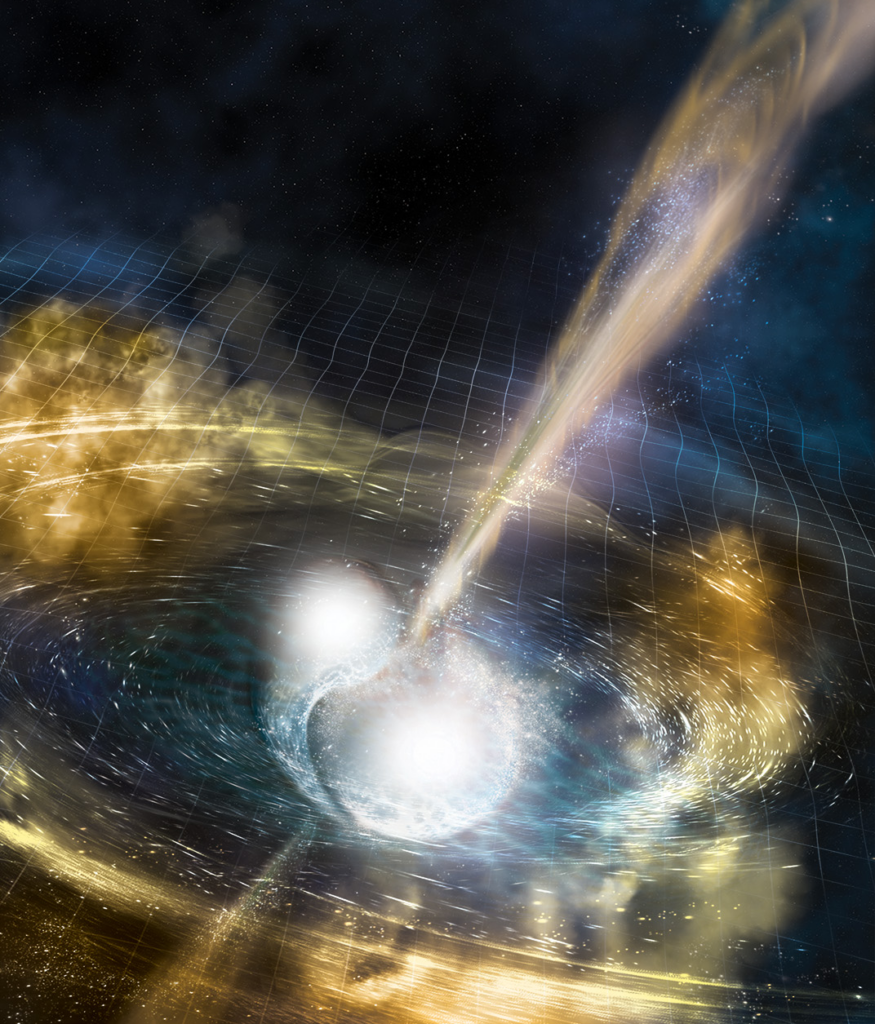
Measuring gravitational waves is a revolutionary new way to do astronomy. In 2015, LIGO (the Laser Interferometer Gravitational-wave Observatory) first detected one of these waves – a tiny ripple in space itself, generated by the collision of 2 black holes. Since then the cumulative number of detections that LIGO and its international partners have measured has exceeded 300, marking a transition from detecting rare events to daily detections. What can we learn from the mergers of black holes or the collision of two neutron stars? How is it possible to measure a wave which stretches our detector 1000 times less than the diameter of a proton? What’s coming next in our search for these tell-tale ripples in space, and what can we learn from these observations that could address a variety of questions such as how black holes form from the collapse of massive stars, the cosmological evolution of the universe and confirming the theory of general relativity? In this presentation, Prof Brian Lantz will cover the emerging astronomy of gravitational wave detection.
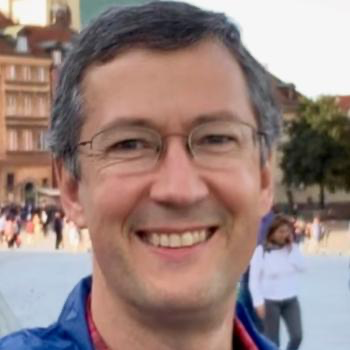
Prof. Brian Lantz is a Research Professor of Applied Physics at Stanford University. He started working on LIGO in 1991 as an undergraduate in Rai Weiss’s lab at MIT and continued there for his Ph.D, building high-power interferometers to prototype LIGO. Prof. Lantz is the scientific leader for the Advanced LIGO seismic isolation system, and he is designing new mirror suspensions to upgrade Advanced LIGO because he loves to work on these amazing machines!
We propose a mission concept for a space observatory with a large-aperture (50-meter) unsegmented primary mirror suitable for a variety of astronomical applications. The mirror would be created in space via a novel approach based on fluidic shaping in microgravity, which has already been successfully demonstrated in a laboratory neutral buoyancy environment, in parabolic microgravity flights, and aboard the International Space Station (ISS). Theoretically scale-invariant, this technique has produced optical components with superb, sub-nanometer (RMS) surface quality.
The San Mateo County Astronomical Society Star Parties, Speaker Series, and meetings are free and open to the public. Free parking in nearby lighted parking lots, easy access to the Planetarium. Speaker Series and meetings happen in person at the College of San Mateo Planetarium. General meetings and socials start at 7:00 pm in Room 110 in the ISC Building (36). Speaker presentations start at 8:00 pm in the Planetarium. Although generally not a problem in CSM’s state-of-the-art, 94 seat Planetarium, plan to arrive early to assure entry, as seats are first-come, first-served, not reserved. Please note that all guests must be seated and there will be no standing allowed due to safety concerns, access into the Planetarium is stopped once the seats are full.
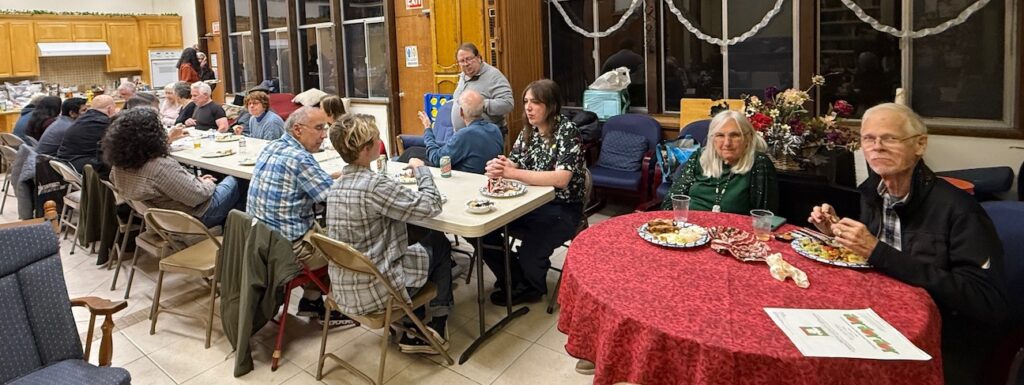
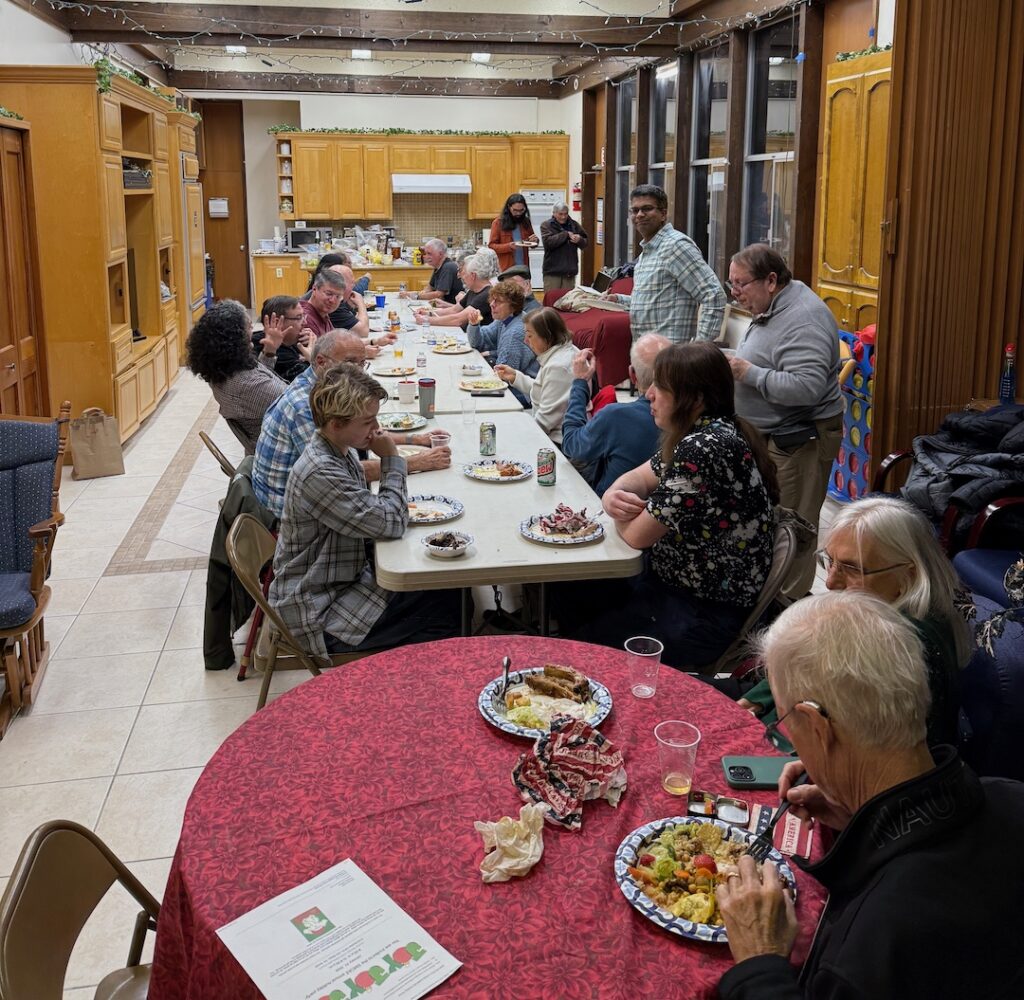
This year’s holiday celebration, held at the Crystal Springs United Methodist Church, took place a week later than usual due to a scheduling conflict, but that didn’t dampen anyone’s spirits January 17. There was another feast of delicious food for everyone who attended. The room was filled with the inviting aroma of savory dishes and festive cookies, making it impossible not to go back for seconds. Laughter and cheerful conversation added to the warm, welcoming atmosphere as guests lingered over their plates and caught up with old friends.
After everyone had their fill, the festivities shifted to the much-anticipated White Elephant gift exchange, which brought plenty of excitement—even for those who simply watched. In the White Elephant exchange, participants typically bring wrapped gag gifts or quirky treasures, adding a sense of surprise and humor to the event. All the gifts are piled together, and names are drawn from a container. When called, you can choose a gift from the pile or, if you’re feeling bold, ‘steal’ a gift someone has already opened.
Society President Michael Cooke pointed out that Karen Boyer, board member and former treasurer, had her gift taken three times for the second year running! Also, for the second year in a row, a popular item was the umbrella with constellations printed on the underside. Those who remember last year’s celebration might recall that this umbrella was one of several fun constellation-themed gifts brought by Ken Lum. Karen, who admitted she tends to lose umbrellas, decided to let someone else enjoy it this year, saying it would be safer in more responsible hands. Another hit of the evening was a miniature tabletop telescope.
We’d love to see your fun photos and hear your hilarious White Elephant stories from our recent holiday celebration—please reach out to share your favorites!
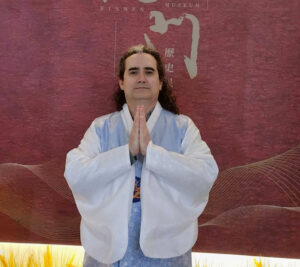
Mary Ann McKay, a fellow SMCAS member, used to volunteer for the villages with Ed Pieret approximately between 2020 and 2022. She shared the following that he prepared for the organization:
“I graduated with a Batchelor in Science in Physics from Clarkson College. During a summer job I discovered I had more of an aptitude with computers than physics, and computers were much more lucrative. I was hired by IBM and spent the next 33 years working for them as a Systems Engineer, helping customers to use their products.
“After retiring I took an astronomy course at the college of San Mate and was encouraged to join the San Mateo County Astronomical Society by the professor. Within a year I became the societies treasurer and have held an executive position since then, including 6 years as president. I am currently the vice president. I have always been interested in outreach and have given many presentations at schools and other venues. I also coordinate our societies public and private star parties.
“I have a website where there are past presentations and general information, www.AstronomerEd.com.”
The villages is a nationwide movement. Their mission is to help seniors who don’t really need to move into assisted living stay in their homes by getting various kinds of support.
Ed Pieret’s family held a casual open house November 29 to share remembrances. In lieu of flowers, they requested donations to the Society.
If you haven’t heard yet, Chanan Greenberg is helping Ed’s family with selling his gear. Many items are still left.
Telescopes Celestron Reflector Tabletop Telescope 76 mm $50
Telescopes Meade XT 125mm $425
Telescopes Celestron C90 1000mm F/11 $100
Barlows 3X Barlow (two) $30
Barlows 2x Barlow made in Japan $25
Barlows Celestron f6.3 reducer / corrector $85
Barlows Televu 1.8X Barlow $70
Cameras Orion Starshhot Color Solar System Camera V4 $30
As we move into March and April, the sky is giving us plenty of reasons to step outside and look up—preferably with a telescope, a few friends, and perhaps a warm drink while the night air still reminds us that winter isn’t quite finished.
March begins with one of the easiest astronomical events to observe: a total lunar eclipse. During a lunar eclipse, the Moon passes through Earth’s shadow and can take on a deep reddish color often called a “Blood Moon.” Unlike solar eclipses, lunar eclipses require no special equipment—just clear skies and the willingness to stay up a little later than usual. They’re perfect reminders that the cosmic clockwork of the solar system is constantly moving above us.
Planetary Pairings and the March Equinox
March also brings a few notable planetary conjunctions, when planets appear close together in the sky. Look for a Venus–Saturn conjunction in early March, followed by a Mercury–Mars pairing in mid-March. These events occur simply because of our line of sight from Earth, but they can create beautiful views through binoculars or small telescopes. Watching planets drift past one another over the course of several nights is a wonderful way to see the solar system in motion.
Later in the month we reach the March equinox, when the Sun crosses the celestial equator and day and night are nearly equal in length. Astronomically, it marks the beginning of spring in the Northern Hemisphere. Practically speaking, it means slightly warmer observing nights—something many astronomers appreciate after a winter spent wondering whether frostbite qualifies as an advanced deep-sky observing technique.
Art, Science, and Stargazing at CSM
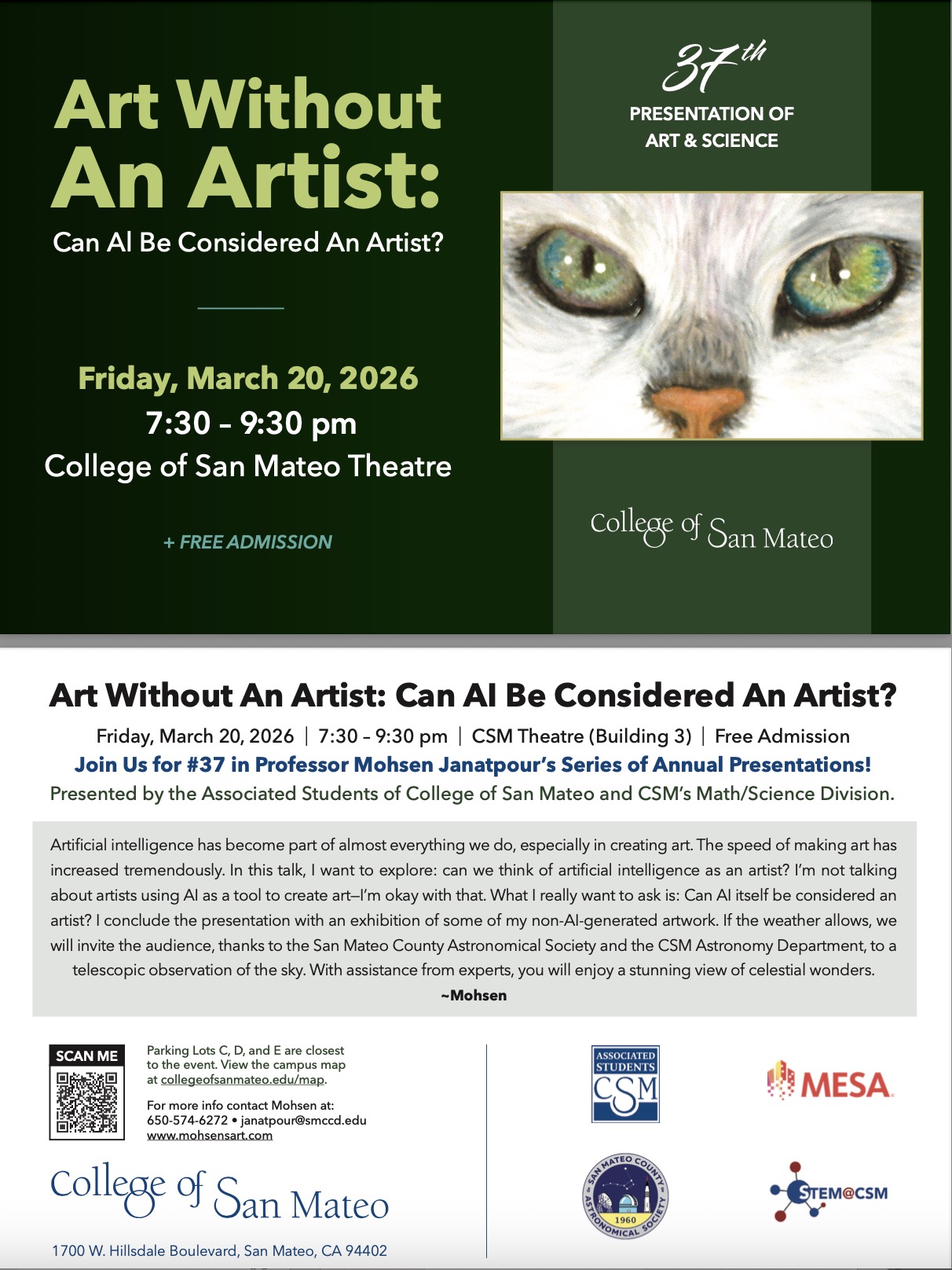
On Friday, March 20, we have a wonderful opportunity to combine art, science, and astronomy. We will once again be participating in Mohsen Janatpour’s 37th annual Art & Science presentation at the College of San Mateo Theatre. Mohsen’s presentations are a long-standing tradition that blend creativity and scientific curiosity in a way that always inspires audiences.
After the presentation, members of the San Mateo County Astronomical Society will set up telescopes for stargazing in the Theatre courtyard, weather permitting. It’s always a fun way to end the evening—moving from talking about the universe to actually seeing it through a telescope. If you’ve never attended before, this is a great event to bring friends or family who are curious about astronomy.
Artemis and the Patience of Launch Windows
Looking a little farther ahead, NASA continues preparing for the next major step in human space exploration: the Artemis program. The upcoming Artemis II mission will send astronauts on a journey around the Moon and back to Earth, becoming the first crewed mission to travel beyond low-Earth orbit since Apollo 17 in 1972. Artemis II will not land on the Moon; its purpose is to test the Orion spacecraft, life-support systems, and the massive Space Launch System rocket with astronauts aboard before future missions attempt lunar landings later in the decade.
One interesting aspect of lunar missions is that they can only launch during specific launch windows, when the positions of Earth, the Moon, and the spacecraft’s trajectory all line up properly. These windows can last only a couple of hours, and if the weather or a technical issue interferes, the launch must wait for the next available opportunity. In other words, even with powerful rockets and modern computers, spaceflight still requires a fair amount of patience.
Another Comet to Watch
Just when you think the sky calendar is already full, another visitor is on the way. Astronomers are tracking C/2025 R3 (PanSTARRS), which will make its closest approach to the Sun around April 20, appearing in the constellation Pegasus in the early morning sky.
As with all comets, it’s still too early to know exactly how bright it will become. I like to say comets are a lot like cats — they both have tails and are wildly unpredictable. It may end up being a nice telescopic target, or with a little luck it could brighten enough to become a naked-eye comet. Either way, it will be another good reason to set the alarm a little early and take a look before sunrise.
A Meteor Shower
April brings one of the spring sky’s best-known meteor displays, the Lyrid meteor shower, which peaks around April 21–22. Under dark skies you may see up to about 20 meteors per hour streaking across the sky. The Lyrids are especially interesting because they are one of the oldest recorded meteor showers, with observations dating back more than 2,500 years.
And since April 21st happens to be my birthday, I like to think the universe schedules a meteor shower every year just to celebrate. Sadly, the meteors have not yet agreed to form a perfectly shaped bassoon—but I remain optimistic.
Throughout April, the Moon will also pass near several bright planets including Venus, Jupiter, and Mars, creating attractive Moon–planet conjunctions that are easy to observe and photograph.
Protecting the Night Sky
While the sky continues to provide plenty of wonders, there are also important conversations happening about protecting it. Recently the Astronomical League shared information about a proposal from a company called Reflect Orbital that envisions placing large numbers of mirror satellites in orbit to reflect sunlight onto Earth at night for commercial lighting.
While the concept may sound innovative, many astronomers are concerned about what reflective satellites could mean for astronomical observations and for preserving naturally dark skies. DarkSky International has posted information about the proposal and instructions for submitting public comments to the FCC. Protecting dark skies has always been an important part of amateur astronomy, and developments like this remind us that the night sky is not only something we observe—it’s something worth protecting.
Join Us Under the Stars
All of these events are reminders that astronomy is best enjoyed together. Whether it’s sharing a lunar eclipse, watching meteors streak across the sky, or introducing someone to Saturn for the first time through a telescope, these experiences are what make our club special.
If you haven’t been to a meeting or observing night in a while, consider this your friendly invitation. Join us at an upcoming meeting, come out to an observing session, or stop by the Art & Science event at CSM. Bring a friend, bring your curiosity, and bring your questions—because the universe always seems to have a few new ones waiting for us.
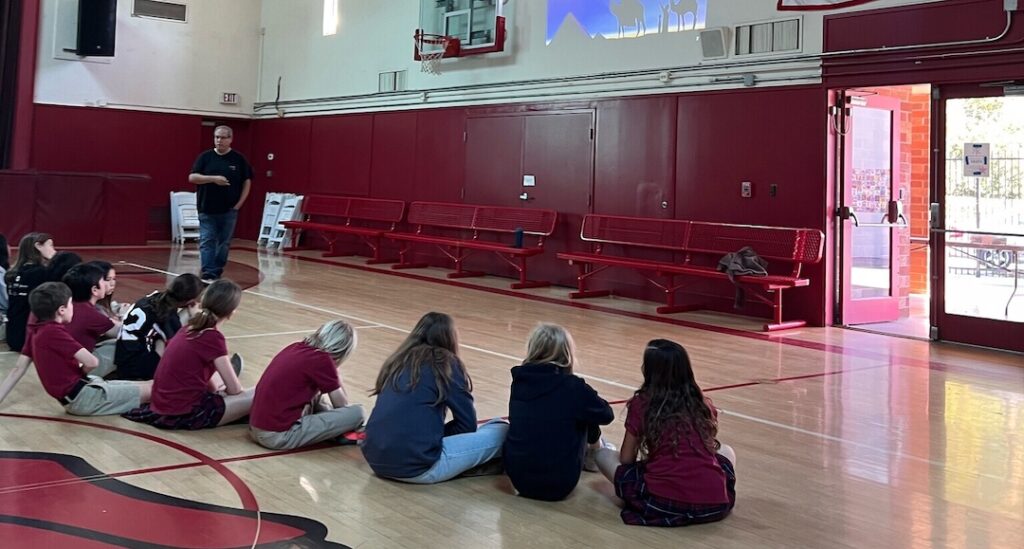
A few board members volunteered for a school assembly at St. Raymond Catholic Elementary School, Menlo Park. It’s also where Board Member Kimberly Alger works. Vice President Jason Zaman and Board Member Chanan Greenberg are the other members that volunteered for this event.
Chanan began with the “Size of the Universe” presentation that covers comparable sizes and distances of the Earth and the Moon, the planets and the Sun, other stars and galaxies with the Sun. The school’s fifth through eighth-grade, around 100 children, attended. Then they moved outside to view through Chanan’s two telescopes and one of Jason’s.
Photo by Kimberly Alger.
Part of Chanan’s presentation also included, “Instructions on Using a Telescope.”Rule #1: Don’t touch telescope. All board members impressed us all when they informed us that not a single child touched any of the telescopes!
From First Light to Feature Film: Preparing Rubin to Record a Decade-long Cosmic Show
Sorry, this event has sold out, tickets no longer available. You may try attending on standby basis, no guarantee of entry.
This event is jointly co-hosted by SMCAS and KIPAC (Kavli Institute for Particle Astrophysics & Cosmology)
Open to the public, please reserve a free ticket through EventBrite here to secure entry. Free Parking in nearby lots.
The Vera C. Rubin Observatory, located on a high mountaintop in Chile, is equipped with an 8.4-meter primary mirror and the largest digital camera in the world, the LSST Camera. Rubin Observatory will soon begin an unprecedented 10-year survey that will repeatedly scan the entire Southern sky every three to four nights. This 10-year color “movie” of the cosmos will help unravel the mysteries of a broad swath of astronomy and cosmology, including the nature of dark matter and dark energy, galaxy formation and evolution, exoplanets and our own Solar System. In this talk, I will introduce Rubin Observatory and its broad science goals and highlight one of the earliest astronomical results produced by the Rubin team: observations of the third known interstellar object, 3I/ATLAS. I will also share my exciting experience of working hands-on at Rubin Observatory in Chile for three months this past year getting LSST Camera ready for its big survey debut.
Theo Schutt is a sixth-year PhD student at Stanford University and SLAC National Accelerator Lab, and a member of the Kavli Institute for Particle Astrophysics and Cosmology (KIPAC). Theo is an observational cosmologist specializing in weak gravitational lensing, the study of how light from very distant galaxies gets deflected by foreground clumps of matter. Their work focuses on analyzing data from the Dark Energy Survey, mapping the lensing of nearly 150 million galaxies to better understand dark energy, the mysterious source driving the accelerated expansion of our Universe. In particular, Theo has worked to improve the methods for disentangling atmospheric and sensor effects from the true cosmological signal. Theo is also involved in the Vera C. Rubin Observatory, having contributed to the characterization and commissioning of the main instrument, LSST Camera, at SLAC and in Chile.
We propose a mission concept for a space observatory with a large-aperture (50-meter) unsegmented primary mirror suitable for a variety of astronomical applications. The mirror would be created in space via a novel approach based on fluidic shaping in microgravity, which has already been successfully demonstrated in a laboratory neutral buoyancy environment, in parabolic microgravity flights, and aboard the International Space Station (ISS). Theoretically scale-invariant, this technique has produced optical components with superb, sub-nanometer (RMS) surface quality.
The San Mateo County Astronomical Society Star Parties, Speaker Series, and meetings are free and open to the public. Free parking in nearby lighted parking lots, easy access to the Planetarium. Speaker Series and meetings happen in person at the College of San Mateo Planetarium. General meetings and socials start at 7:00 pm in Room 110 in the ISC Building (36). Speaker presentations start at 8:00 pm in the Planetarium. Although generally not a problem in CSM’s state-of-the-art, 98 seat Planetarium, please reserve a free ticket through EventBrite here, and plan to arrive early to assure entry, as seats are first-come, first-served, not reserved. Please note that all guests must be seated and there will be no standing allowed due to safety concerns, access into the Planetarium is stopped once the seats are full.
The Artemis missions aren’t just about landing on the Moon, they’re also about learning how to stay there, and go farther. Artemis will be the second time we set foot on the moon since the Apollo missions in 1961, and it will not only be vital for gaining scientific knowledge but will also help us in understanding our universe more. While Apollo was one of mankind’s greatest achievements, Artemis is sure to give us even greater results, considering how much more developed our technology has become over the years.
Firstly, the main difference is the size of the capsule in the spacecraft and the amount of personnel. Apollo’s space capsule only had room for three astronauts, while Artemis has room for four, allowing us to conduct more productive research on the moon. The capsule will also be approximately 110 cubic feet larger than the Apollo capsules.
Another way that Artemis trumps Apollo is that their rocket is far more advanced. The Space Launch System (SLS) is the most powerful rocket that has been created so far. It is currently the only rocket able to launch the Orion spacecraft, four astronauts and heavy supplies out of Earth’s atmosphere! The rocket is made up of a core with four RS-25 boosters attached to it. As of this month, the SLS for the Artemis II mission has just completed its rollout to Launch Pad 39B at Kennedy Space Center, preparing for the first crewed lunar mission in over 50 years!
As we know, Apollo safely carried humans to the Moon and back. But what if we could go even farther? Artemis aims to use this launch as a teaser of sorts, with the end goal being to find a way to send humans to Mars. Developing sustainable technology on the Moon is the strategic prerequisite to Mars, ensuring that all angles are accounted for. By mastering lunar survival and exploration today, NASA is paving the way for the first human footprints on the Red Planet in the next decade, or even as soon as 2030!
So, who are the lucky astronauts who get to go to the moon? NASA has appointed Christina Koch, Victor Glover, Reid Wiseman, and Canadian Space Agency Astronaut Jeremy Hansen to fly out. Christina Koch will be the first woman ever to leave Earth’s orbit, paving the way for more women to follow in her steps! Victor Grover will be the first black man to travel to the Moon, serving as the pilot for the missions. Reid Wiseman will serve as the commander, and as a former Chief in the Astronaut Office and veteran astronaut in the International Space Station, he is certainly more than qualified! Lastly, Jeremy Hansen is the mission specialist and can’t wait to be the first Canadian to the Moon!
Artemis II NASA astronauts (left to right) Reid Wiseman, Victor Glover, and Christina Koch, and CSA (Canadian Space Agency) astronaut Jeremy Hansen stand in the white room on the crew access arm of the mobile launcher at Launch Pad 39B as part of an integrated ground systems test at Kennedy Space Center in Florida on Wednesday, Sept. 20, 2023. The test ensures the ground systems team is ready to support the crew timeline on launch day. (NASA/Kim Shiflett)
We’re excited to announce that this year’s Society Annual Holiday Party will be held a little later than usual, but it promises to be a wonderful evening! If you haven’t already, mark your calendars for Saturday, January 31, from 6 p.m. to 9 p.m. at the welcoming Crystal Springs United Methodist Church (2145 Bunker Hill Drive, San Mateo).
🍽️ Potluck Dinner Enjoy a delicious potluck feast, with main dishes provided by our dedicated board members. We invite you to bring your favorite sides, salads, or desserts to share with friends and fellow members. Let’s make this a meal to remember!
🎁 White Elephant Gift Exchange Join in the fun with our new tradition—the White Elephant Gift Exchange! Bring a “gag” gift (up to $30) or something truly unique. All gifts will be placed in a pile, and as names are drawn, each participant can pick a new gift or “steal” one from someone else. Whether you bring a gift or just watch, you’re sure to enjoy the laughter and surprises.
📝 Sign-Up Sheet If you missed the invitation sent by Michael Cooke on January 6, you can still RSVP by adding your name to the sign-up sheet. Please let us know how many guests will be in your group, what dish or beverage you plan to bring, and whether you’d like to join the gift exchange.
💬 Questions? If you have any questions or concerns, please reach out to any of our board members SMCASBD@groups.io. We’re here to help and look forward to celebrating with you!