Hans von Aachen, Public domain, via Wikimedia Commons
By Alexander Jaeger
My favorite astronomer is Johannes Kepler. Ever since I took an introductory course in astrophysics, I have been fascinated by Kepler because of his laws of planetary motion. It seemed so amazing to me that such a complex topic could be described by laws that appeared so simple. I think that his work was incredibly significant because it helped disprove the theory of “planetary orbs” (orbs which planets were attached to and thus derived their orbits from) and established the idea that astronomical phenomena were governed by physical laws.
I also admire the fact that he endeavored to find a physical explanation for planetary motion in a time when prior assumptions and supernatural explanations were deeply ingrained and accepted in society. Though he was religious and had an interest in astrology, his dedication to the sciences enabled him to largely separate these influences from his work, which I think is a truly laudable feat, especially during this time period. Additionally, because the word of the church was considered law by many, Kepler was also putting himself at risk of retaliation as he continued his research and published findings that did not align with church-approved theory (as seen by how his books were banned by it).
Because many of his findings were not accepted at the time (and indeed, for decades to come), even by those most prevalent in the field such as Galileo, I greatly admire his persistence in his inquiry. I can imagine how difficult it would be to not to doubt my own work and continue if everyone around me disagreed with and ignored my findings—not to mention that the findings also went against many of the accepted explanations for the same things they described! I look up to Kepler as a role model for how to approach scientific inquiry, and hope that in the future I can also participate in groundbreaking research, like he did!
I hope you all made it through the holidays with minimal cloud cover, functional eyepieces, and only a reasonable number of telescope accessories added to your wish list.
January and February are often thought of as the “quiet” months for astronomy — cold nights, early sunsets, and the temptation to stay indoors. But in reality, the winter sky is one of the most rewarding times to observe. Fewer insects, steadier air, and some of the most iconic constellations of the year make it well worth bundling up and heading outside.
Winter Skies: Bright, Bold, and Unmissable
Orion dominates the evening sky right now, and with it comes a whole supporting cast of celestial show-offs: Taurus, Gemini, Auriga, and Canis Major. This is prime season for bright star clusters and nebulae — objects that don’t require dark-sky perfection or heroic endurance to enjoy. Even a short session — perhaps between dinner and bedtime — between dinner and bedtime can be deeply satisfying.
If you’re new to observing, this is a fantastic time to learn the sky. If you’re experienced, it’s a great excuse to revisit familiar objects and notice details you may have missed before. (Ask yourself: Have I really looked at Orion lately, or have I just been nodding at it politely for years?)
January Highlights
Early January brings the Quadrantid meteor shower, one of the strongest showers of the year — though its peak is brief and often weather-dependent. Even if clouds interfere, the attempt itself counts. Astronomy is, after all, an exercise in optimism.
January is also a wonderful month for planetary observing. Jupiter remains a bright evening target, and Mars continues to improve in visibility as we move deeper into winter.
February: Short Nights, Big Payoff
February nights are still long, but the promise of spring begins to peek through. This is an excellent month for deep-sky observing, especially open clusters and winter nebulae. It’s also a great time to experiment with binocular astronomy — sometimes the simplest tools offer the most joy.
Don’t Forget the Holiday Party
Although there’s no meeting in January, don’t miss our Annual Holiday Party on January 31th, 2026! keep an eye out for an invite. It’s a chance to relax, connect with fellow members, and celebrate the start of another year of stargazing, outreach, and discovery. Whether you’re a longtime member or newer to the society, we hope you’ll join us.
Looking Ahead as a Society
As we move into 2026, I’m excited about what lies ahead for SMCAS. We’ll be continuing our public outreach, star parties, and educational events — all with the shared goal of keeping astronomy accessible, welcoming, and fun. Whether you’re a longtime member or brand new, your curiosity and enthusiasm are what keep this society vibrant.
So here’s my gentle winter challenge to you: pick one clear night over the next two months, step outside, and really look up — even if it’s just for ten minutes. The universe is still doing amazing things, whether or not we’re wearing three layers and gloves with the fingertips cut off.
Presentation on 12/5/2025, 8:00pm PST in the CSM Planetarium
Chanan Greenberg: Astrophotographer
Capturing Cosmic Magic through Astrophotography
Free and open to the public.
Screenshot
Why do people bother with astrophotography, especially when high quality images are available for free from professional telescopes? In this presentation you will learn about the joy and magic of capturing images of cosmic objects, understand what is being captured, and details of how to go about it! Learn about what’s in an image – the exciting physics seen in an image. Understand the different flavors of Astrophotography: Smart Phones, Digital Cameras, Electronic Telescopes and Dedicated Astrophotography Cameras. How to capture differing types of images such as nightscapes, solar system and deep space images. And lastly learn about astrophotography image processing for Solar System and Deep Space.
Whether you just want to learn more about how these images are created so you can appreciate them; want to start creating them yourself; or are an experienced astrophotographer wanting improve (and share your experience with us), there is something for everyone in Chanan’s presentation!
Chanan Greenberg is an amateur astronomer and award-winning astrophotographer. A member of the San Mateo County Astronomical Society for over 20 years, his images are featured on his website: www.greenhawkobservatory.com. He is also a member of the Fremont Peak Observatory Association and a certified operator of the 30” Challenger Telescope. Professionally, Chanan has spent 25 years as an executive in the B2B enterprise software space, leading startups through scale-ups, IPOs, and private equity acquisitions.
The San Mateo County Astronomical Society Star Parties, Speaker Series, and meetings are free and open to the public. Free parking in nearby lighted parking lots, easy access to the Planetarium. Speaker Series and meetings happen in person at the College of San Mateo Planetarium. General meetings and socials start at 7:00 pm in Room 110 in the ISC Building (36). Speaker presentations start at 8:00 pm in the Planetarium. Although generally not a problem in CSMs state-of-the-art, 98 seat Planetarium, please arrive early to assure entry and seating, as seating is first-come, first-served, not reserved. Please note that all guests must be seated and there will be no standing allowed due to safety concerns, access into the Planetarium stopped once the seats are full.
We received word that another longtime board member and member, Ed Pieret, passed the morning of October 30. If you didn’t see the email that was sent to the Society this is what the president sent October 31:
Dear SMCAS Members, It is with deep sadness that I share the news of the passing of our dear friend and longtime SMCAS member, Edmund “Ed” Pieret, who passed peacefully in his sleep early this morning, October 30th, with his wife by his side. His granddaughter, Loki, shared the following: “I regret to inform you that at around 6 AM this morning, October 30th, Edmund Pieret passed away in his sleep. He went peacefully with his wife by his side. Thank you all for your support and kindness over the past few months—it has meant everything to us. I’ll keep in touch about funeral dates and such as we figure things out. ♥️”
Over the years, Ed served SMCAS in many important roles—including President and Vice President—and contributed tirelessly to our club’s mission of sharing the wonders of the night sky. His energy, generosity, and enthusiasm left a lasting mark on our astronomical community.
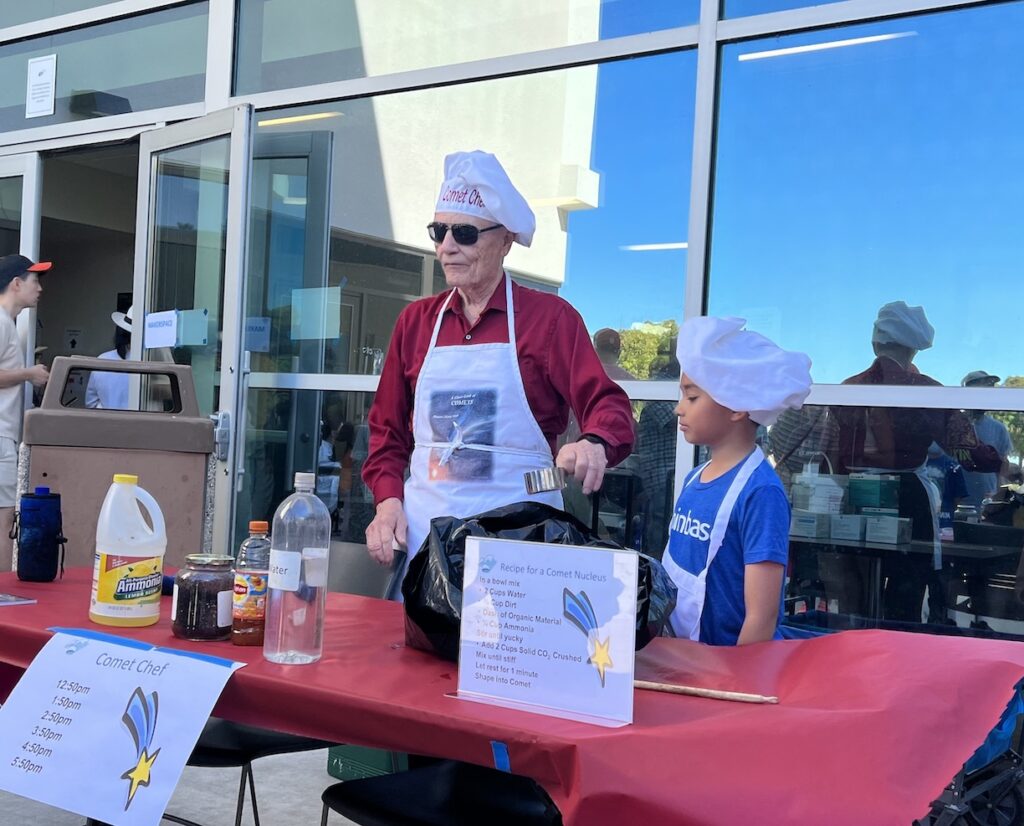
College of San Mateo’s Family Science Day 2022
Members may recall his “Comet Chef” presentation and his many appearances at star parties and school events (as noted in the club newsletter). smcas.net We will share further details about services or a memorial gathering as soon as they are finalized by Ed’s family. For now, let us hold space in our thoughts for his loved ones and for the light he shared with us. With heartfelt sympathy, Michael Cooke SMCAS President
Please share a photo or memory or even both of Ken by emailing mmorales_sf@yahoo.com to be posted on the Event Horizon.
It is with deep sadness that I share the passing of our longtime member and past president, Ed Pieret, who left us peacefully on October 30 with his wife by his side. Ed served SMCAS in many roles over the years — President, Vice President, mentor, and friend — and his energy, humor, and generosity left an indelible mark on our community. Many will fondly remember his “Comet Chef” presentation and his tireless enthusiasm at star parties and school events.
We also pause to remember Ken Lum, another cherished member we lost earlier this year. Both Ed and Ken embodied the curiosity and kindness that make our society so special. Their passion for the night sky will continue to shine through all of us who look upward in wonder.
Celestial Highlights & Year in Review
As 2025 winds down, the skies are still serving up plenty of beauty to close out the year:
November 16–17 – Leonid Meteor Shower: Known for its swift, bright meteors, this year’s Leonids arrive under a dark sky with minimal moonlight — great conditions for viewing.
December 13–14 – Geminid Meteor Shower: One of the best annual showers, often producing over 100 meteors per hour at its peak.
December 21–22 – Ursid Meteor Shower: A quieter but charming show in the final nights before Christmas, with almost no moonlight interference.
November’s Beaver Moon and December’s Cold Moon will both appear slightly larger than usual as near-perigee “supermoons.”
Looking back, 2025 brought us some memorable sights — the brief “disappearing rings” of Saturn as they turned edge-on, a visit from interstellar Comet 3I/ATLAS, and the excitement of NASA’s ESCAPADE launch to Mars. A good year to remind us how much there still is to explore, both near and far.
Wishing You Clear Skies
As we gather for the final meetings of the year and head into the holidays, let’s take a moment to appreciate the people who make this society shine as brightly as any star. Thank you all for your enthusiasm, your generosity, and your shared love of the cosmos.
Wishing everyone a safe, joyful, and peaceful holiday season — and clear skies for the year ahead.
Presentation on February 6, 8:00 pm PST in the CSM Planetarium
Speaker: Dr Sofia Sheikh, Technosignature Research Scientist, SETI
Searching for Technological Life in the Universe
Free and open to the public. Free Parking in nearby lots.
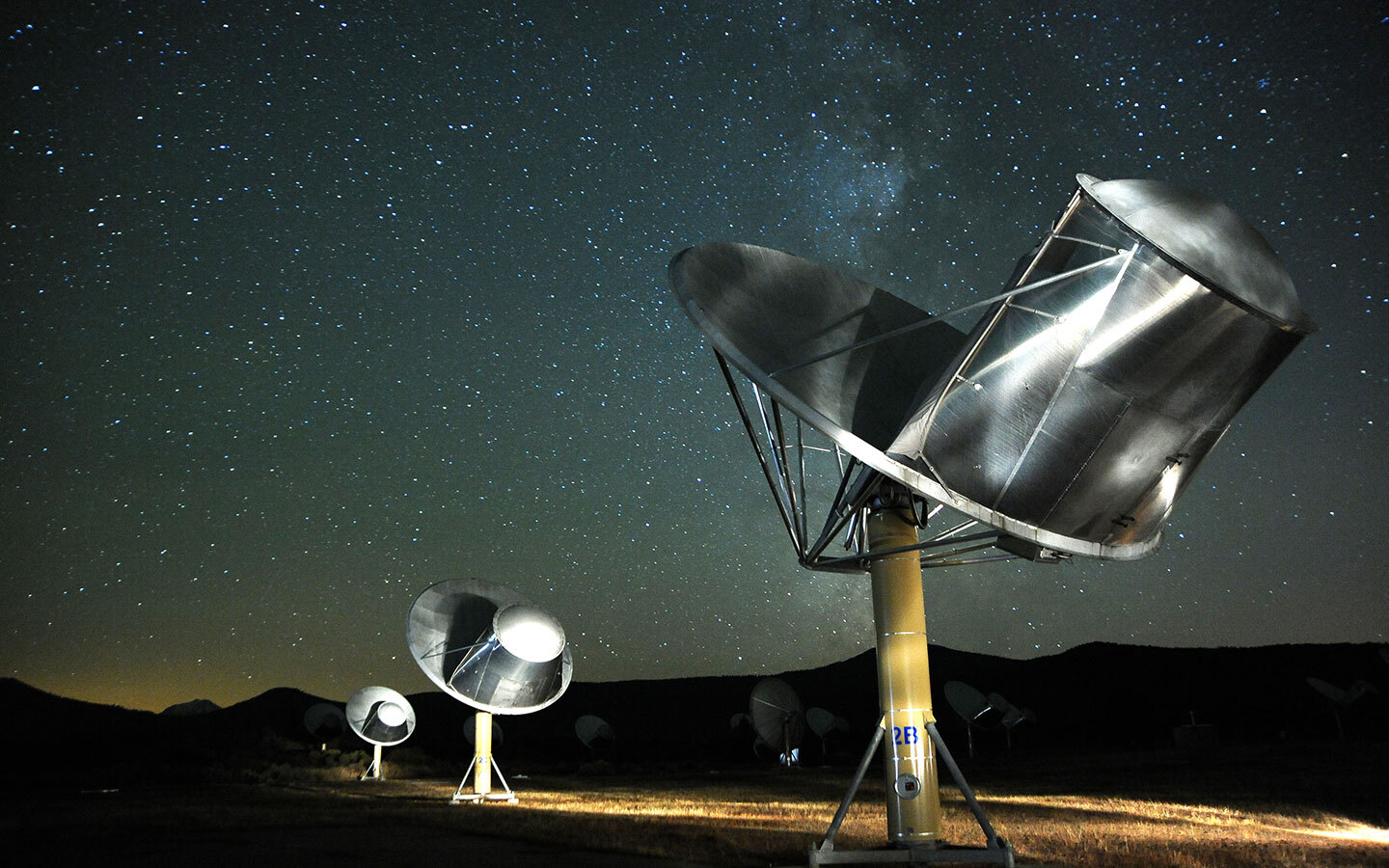
An image of the 42-dish Allen Telescope Array (ATA), at the Hat Creek Radio Observatory in Northern California. The ATA is used to conduct radio astronomy research, including searching for “technosignatures” from radio transmitters built by other life in the galaxy. (image Seth Shostak, SETI Institute)
Are we alone? Or is there other life out there in the universe beyond Earth? If there is other life, is it complex life, capable of using language and creating technology like us? Dr. Sofia Sheikh seeks to answer this question by using facilities like the Allen Telescope Array to search for “technosignatures,” or signs of non-human technology elsewhere in the universe. In this talk, Dr. Sheikh will describe the current status of technosignature searches, including the history of the field of “SETI” (Search for Extraterrestrial Intelligence), the progress we’ve made so far in searching for extraterrestrial signals, and the cutting-edge surveys and instruments that will advance our understanding in the years to come.
Dr. Sofia Sheikh is a radio astronomer who works on the search for “technosignatures” (SETI), as well as fast radio bursts, pulsars, and characterization of radio frequency interference. She completed her bachelor’s degrees in physics and astronomy at the University of California, Berkeley in 2017, and went on to earn a dual-title PhD in Astronomy & Astrophysics and Astrobiology at Penn State University in 2021. She led radio campaigns with the SETI Institute’s Allen Telescope Array as an NSF MPS-Ascend post-doctoral fellow, and now works with the SETI Institute as a Technosignature Research Scientist. She hopes, through her career, to help us learn more about the distribution of technological life in the galaxy.
We propose a mission concept for a space observatory with a large-aperture (50-meter) unsegmented primary mirror suitable for a variety of astronomical applications. The mirror would be created in space via a novel approach based on fluidic shaping in microgravity, which has already been successfully demonstrated in a laboratory neutral buoyancy environment, in parabolic microgravity flights, and aboard the International Space Station (ISS). Theoretically scale-invariant, this technique has produced optical components with superb, sub-nanometer (RMS) surface quality.
Presentation on November 7, 8:00pm PST in the CSM Planetarium
Speaker: Astronomy Professor Darryl Stanford
College of San Mateo
Planetarium Show – The Sky Tonight
Plus Full Dome Movie:
Incoming!
Free and open to the public. Free Parking in nearby lots.
Embark on a journey back in time and across the Solar System, following the paths of asteroids and comets that have collided with Earth—and those that roam far from home. These ancient objects travel billions of years before reaching Earth, and their impact can be so powerful that just one collision can change the course of life on our planet.
Scientists aren’t waiting for asteroids and comets to come to us to learn more about them—get an up-close look at spacecraft sent to rocky asteroids and icy comets to collect invaluable data. You’ll follow the trek of the Chelyabinsk meteor as it entered the Earth’s atmosphere in 2013 and visualize major shifts in the history of the Solar System billions of years in the making. Narrated by George Takei.
Sit back and enjoy this show in the College of San Mateo’s state of the art Planetarium!
We propose a mission concept for a space observatory with a large-aperture (50-meter) unsegmented primary mirror suitable for a variety of astronomical applications. The mirror would be created in space via a novel approach based on fluidic shaping in microgravity, which has already been successfully demonstrated in a laboratory neutral buoyancy environment, in parabolic microgravity flights, and aboard the International Space Station (ISS). Theoretically scale-invariant, this technique has produced optical components with superb, sub-nanometer (RMS) surface quality.
Darryl Stanford has been an Astronomy Professor at the College of San Mateo since 1996. He received his B.S., Physics, at the Polytechnic Institute of New York; an M.S., in Solid State Physics at Concordia University, Montreal, Canada; and an M.S, in Astrophysics at the University of Toledo. His other interests include riding his Harley, playing with his dogs, amateur astronomy, learning new languages, and playing his conga!
The San Mateo County Astronomical Society Star Parties, Speaker Series, and meetings are open to the public. Speaker Series and meetings happen in person at the College of San Mateo Planetarium. General meetings and socials start at 7:00 pm in Room 110 in the ISC Building (36), and Speaker presentations start at 8:00 pm in the Planetarium.
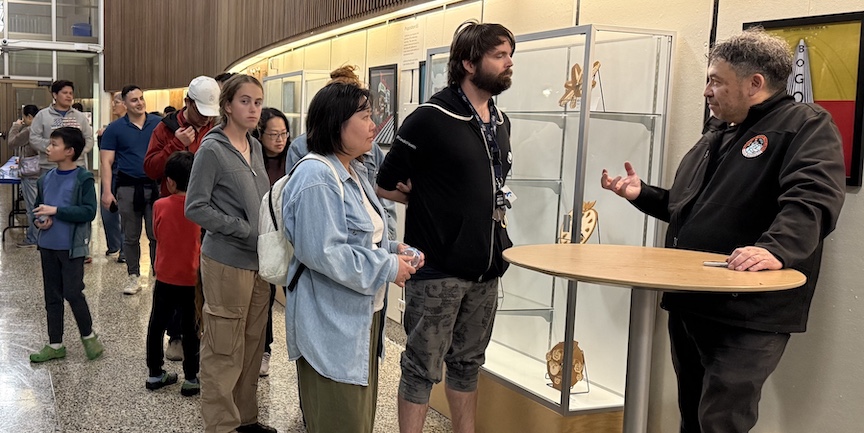
This year’s Family Science Day at the College of San Mateo broke recent attendance records with an estimated 2,500 attendees! It was so successful that the Planetarium is considering doubling the number of shows next year to accommodate demand.
Photo by Marion Weiler.
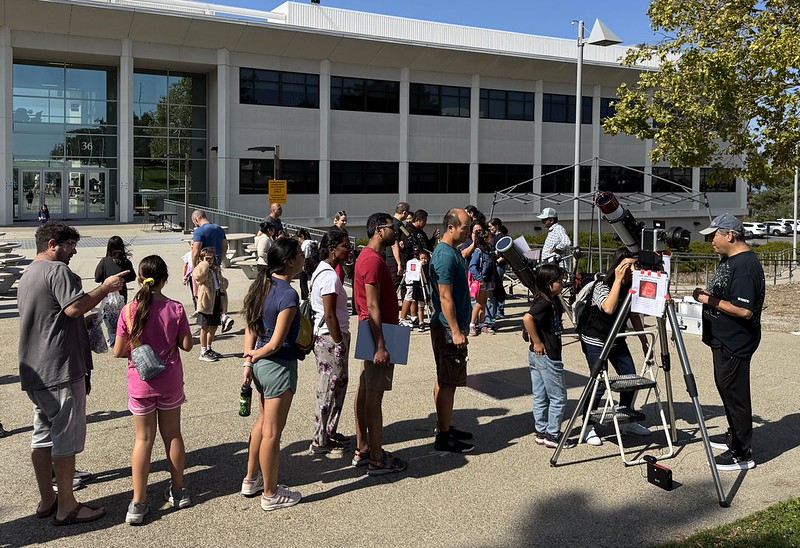
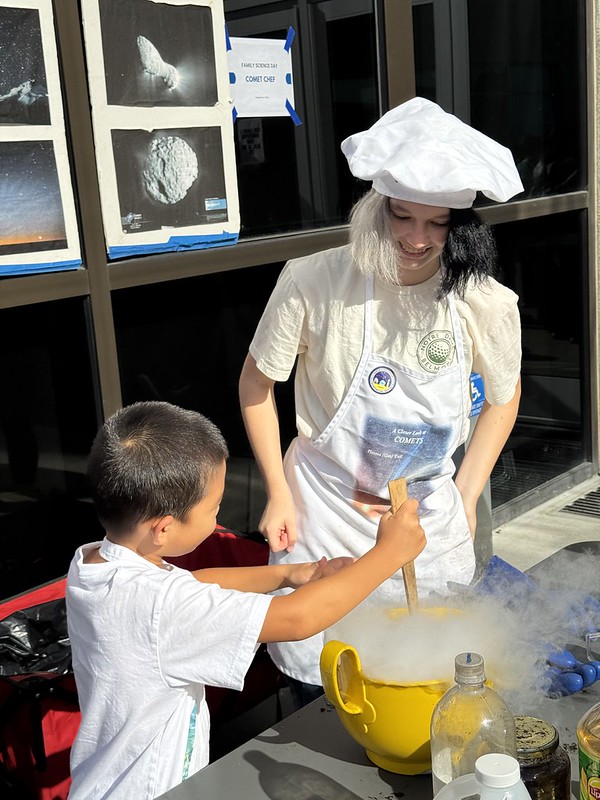
Although it was the first time without a couple of our dear long time board members, homage was given to them in their own ways. For instance, in the absence of Ken Lum, the Society had his solar scope bearing his name. His absence was sorely missed but many felt his spirit through his telescope. Long lines demonstrated its popularity, as with many of the activities at the event. Then in the absence of our well known Comet Chef, Ed Pieret, we were fortunate to have his eager granddaughter, Loki Ingalls, step-in to carry on his tradition. She told the Board she grew up seeing him give these demonstrations and it was obvious as she interacted with the crowds and the children.
Photo by Marion Weiler.
The evening presentation was successful with approximately 130 people attending Dr. Pascal Lee’s talk about going to the moon and Mars. It was a condensed version of the two presentations that he gave to the Society March 7 and May 2. Many patrons lined up and waited several minutes to have the chance to follow up with Dr. Lee.
Photo by Michelle Morales Torres
Thank you to everyone below who helped with delivering the wonder of science and astronomy to the community this year! Below is this year’s SMCAS team that made it happen. (Hopefully no one was missed.)
Ken Lum Solar Viewing Scope: Chanan Greenberg, Ravi Kumar, Jason Zaman Comet Chef: Loki Ingalls How a Telescope Works: Kimberly Alger, Karen Boyer, Stephen Kwong, Caleb Kwong, Marion Weiler and three student volunteers Planispheres: Ed Ching, Michele Morales Torres and four student volunteers Solar System Model: Michael Cooke Membership Table: Andy & Alexa Thanos Reception Catering: Karen Boyer, Ed Ching, Michelle Morales Torres, Marion Weiler and four student volunteers Shopping, snack room, pizza run: Colette Rudd, Marion Weiler
When I was just a little girl, I would look up at the night sky with awe, surprised that such beauty existed. It wasn’t until I discovered Neil DeGrasse Tyson that I started to understand what really happened in the vast vacuum that is our universe. Tyson was born in New York City and went on to earn a bachelor’s in physics and a doctorate in astrophysics. As the years past, he’s accumulated many credentials, like serving on a twelve-member commission that studied the future of the U.S. aerospace industry, being appointed by former President George W. Bush, among many other achievements.
As a child, Tyson often climbed to the top floor of the Skyview Apartments where he lived to stargaze. His parents were very supportive of his astronomy interests and regularly visited the Hayden Planetarium, which he is now the director of! In 1970, Tyson got a telescope for his twelfth birthday, which resulted with his interest in the cosmos skyrocketing into an obsession.
What makes him so special to me are his books and his YouTube channel, StarTalk. I love spending time watching his videos, where he speaks so passionately about astronomy. I’ve learned so much from him, and the way he explains things is so simple for someone like me to understand, since I knew almost nothing about astronomy before learning about him. He is one of my inspirations to pursue astrophysics as a career, and I’d love to meet him in person one day.
On September 14, I observed the launch of the NG-23 Cygnus Resupply Mission to the International Space Station from Space Launch Complex 40. The launch vehicle was a SpaceX Falcon 9, carrying the Cygnus XL spacecraft. The mission delivered over approximately 10,828 pounds of scientific investigations, research materials and cargo to the International Space Station. On paper, it was “just” a resupply mission. In person, it was anything but.
Photo by Timothy Milligan.
Liftoff occurred at 6:11 p.m. (EDT), precisely on schedule. The skies around Kennedy Space Center were mostly clear, with only a few cumulus clouds in the distance. It was a beautiful Florida day, with the temperature at a comfortable 83 degrees. This was my first time attending a Falcon 9 launch from the official NASA Press Site, which is on the Kennedy Space Center. Standing approximately 6.2 miles from the launch pad, which is actually located on the Cape Canaveral Space Force Station. I wasn’t quite sure what to expect, particularly in terms of launch trajectory and booster return. Fortunately, the rocket’s direction was easy enough to follow visually, but the booster’s reentry burn proved harder to track. In front of me, a tracking camera, belonging to a major online platform, was already aimed at the sky. Following its guidance, I looked up just in time to see what resembled a bright firework at the zenith. A large, fiery bloom marked the Falcon 9’s reentry burn, used to slow its descent back through Earth’s atmosphere. Moments later, a collective murmur spread through the press observers: “There it is!” The Falcon 9 booster became visible as it descended gracefully toward Landing Zone 2. Then came the telltale sound: three sharp sonic booms echoed across the flat landscape, followed by the bright visual of the booster lowering itself behind the tree line for a precise, controlled landing. While the visual spectacle was stunning, what stood out most was the intensity of the sonic booms, which felt louder than the initial launch sound. I heard three sonic booms in quick succession, a rapid triple report that echoed sharply across the press site. The sensation was physical as well as auditory, it felt like someone lightly pounding on your chest, each boom delivering a soft, percussive thump that you could feel. Then came the echoes off of the buildings. It felt like the sound would never stop, bouncing and rolling across the landscape. These booms were generated by different parts of the booster, typically the engine section, interstage and grid fins, as they broke the sound barrier during descent. This observation aligns with research by Mark C. Anderson and Kent L. Gee, who found that: “For observers farther than 2 km (approximately 1.25 miles) from the launch and landing locations, the sonic boom peak overpressure exceeds the peak pressures experienced during the launch.” 1 This was certainly my experience. Although individual perception varies depending on atmospheric conditions and terrain, their data support the idea that sonic booms can register more forcefully than launch acoustics at certain distances, particularly in open areas like the NASA Press Site. Words like “wow,” “amazing,” and “spectacular” only begin to describe how I felt witnessing this launch. The weather was perfect, the countdown proceeded without delay, and ignition occurred precisely on time. Most importantly, the launch was not “scrubbed,” a dreaded word around Kennedy Space Center. Being at the Space Center’s press site, a place I’d only ever seen on television or online, was surreal. The nostalgia, the triumphs, the tragedies … it’s all part of the history here. I felt honored. Humbled. But I was also there to work, to cover the launch from Space Launch Complex 40.
Photo by Timothy Milligan.
As thrilling as it was to see the Falcon 9 lift off in person, it’s essential to remember the purpose behind it. The ISS, is only as valuable as the international crew that lives aboard it, conducting research, maintaining systems, and representing a global effort in space exploration. Before this experience, I might have thought: “It’s only a resupply mission.” But not anymore. These missions are the lifeblood of the ISS. Without them, the station would soon become uninhabitable. Every launch is critical. Every payload matters. Every person involved is part of something extraordinary. For more than 25 continuous years, humanity has maintained a presence on the ISS. Expedition 1, launched in 2000, began with just three crew members. As of this writing, Expedition 73 consists of 10 astronauts, a significant increase in both personnel and capability. When was the last time you had 10 people living in your house? Thankfully, the ISS is equipped with three toilets to accommodate that many residents. 2 But life aboard the station involves more than just work, although, what a place to work. Everything we take for granted on Earth, such as breathable air, clean water and tasty food, must be transported or produced onboard. Most of these essentials are delivered via uncrewed resupply missions, including Northrop Grumman’s Cygnus, SpaceX’s Cargo Dragon, JAXA’s HTV and Russia’s Progress spacecraft. These launches are not just about rockets; they are lifelines to the low Earth orbiting ISS. After 25 years of continuous human presence aboard the ISS, it’s easy to forget just how hard it is to keep people alive in space. It takes constant effort, vigilance, and an unwavering belief in the mission. Complacency is not an option. Not when the stakes are this high. I grew up in the 1960s, fortunate enough to witness the live broadcast of Neil Armstrong’s first steps on the Moon, July 20, 1969. NASA has been a part of my vocabulary since I was 5 years old. So, decades later, standing at NASA’s press site to cover a space launch, I felt like I’d come full circle. As Sgt. Joe Friday from the classic TV series Dragnet would say, “Just the facts, sir.” So here are some facts that might just baffle your mind. All of the following figures are documented on NASA and related agency websites though the data is spread across multiple sources. 3 Total cargo flown to the ISS: 999,822.73 pounds, just shy of 1 million. This includes consumable supplies such as air, water, food and fuel. This figure does not include six launches for which I could not find data, nor does it account for launches that failed to deliver their cargo to the ISS. It also excludes manifest items not intended to be brought inside the ISS, such as satellites and special scientific investigations. To help visualize this: imagine a fully loaded Boeing 747 jet, complete with passengers, luggage and yes, even the kid kicking the back of your seat. That’s the scale we’re talking about. Let’s break it down further: • Total unmanned cargo flights: 169 • Failed missions: 5 • Fuel delivered: 126,597 pounds • Air delivered: 8,444 pounds • Water delivered: 58,648 pounds • Food: Not listed separately in most sources, but rest assured, they’re not starving up there. Let’s take a quick look at how the ISS got there. Its first component was launched by Russia. The Functional Cargo Block was deployed November 1998. 4 It took two more years of construction before the permanent habitation of the ISS started in October 2000. 5 This year we are celebrating the 25th anniversary of habitation on the ISS.
Now, for a fun visual. Imagine you’re floating through the ISS and decide to visit the newly opened (and entirely fictional) ISS Star Hop Bar. You secure your feet in the stirrups on the floor and ask for a whiskey and Coke. The bartender smiles. You follow up with, “What’s the house wine?” Again, just a smile. Finally, you ask for something simple, just some water. He brings you a small bag containing about 8 ounces. Then he slides you the bill. You gasp. $680 for a bag of water? The bartender sees the look on your face. The bartender shrugs and says, “That’s our SpaceX special price. It used to be higher.” You both laugh. As history reminds us, spaceflight is not easy. It is dangerous. It is expensive. It can be deadly. Spaceflight is hard. Complacency is deadly. Two simple truths that are easy to forget when I look up at the night sky and see the International Space Station silently orbiting overhead. But its presence is no accident. The ISS was designed to pass over 90% of the world’s population a constant reminder that “We are up here.”6 So next time the ISS passes overhead, step outside, whether with a telescope, binoculars or just your own eyes, and take a moment to reflect. If you’re lucky, you might even catch it transiting the Sun or Moon.7 But remember: the ISS is more than a piece of hardware orbiting Earth. It is humanity, science, life and above all, hope, circling above the only home we have.
Self portrait of and by Timothy Milligan.
Timothy Milligan is a freelance reporter is an avid astrophotographer and a member of the Astronomical League and was awarded the “Imaging – Messier Observing Program” on September 12.
References:
Acoustical Society of America, February 2025, “Why does the Falcon-9 booster make a triple sonic boom during flyback?” ↩︎
Guinness World Records,2021, Most Toilets in a Space Station ↩︎
Wikipedia, Uncrewed Spaceflights to the International Space Station ↩︎
NASA, 2015, “Reference Guide to the International Space Station,” 78 ↩︎
NASA, 2015, “Reference Guide to the International Space Station,” 89 ↩︎