Presentation on February 6, 8:00 pm PST
in the CSM Planetarium
Speaker: Dr Sofia Sheikh, Technosignature Research Scientist, SETI
Searching for Technological Life in the Universe
Free and open to the public. Free Parking in nearby lots.
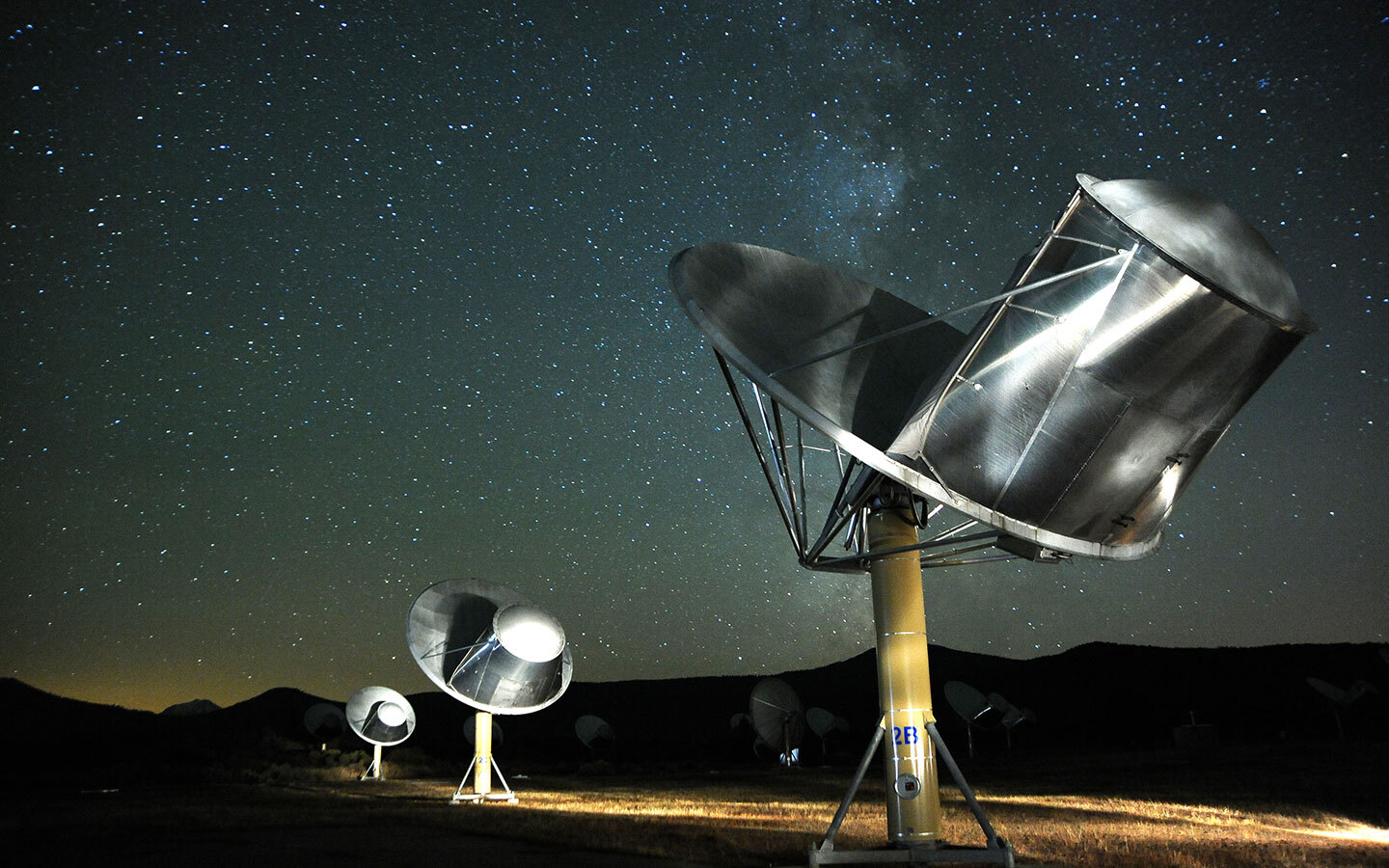
An image of the 42-dish Allen Telescope Array (ATA), at the Hat Creek Radio Observatory in Northern California. The ATA is used to conduct radio astronomy research, including searching for “technosignatures” from radio transmitters built by other life in the galaxy. (image Seth Shostak, SETI Institute)
Are we alone? Or is there other life out there in the universe beyond Earth? If there is other life, is it complex life, capable of using language and creating technology like us? Dr. Sofia Sheikh seeks to answer this question by using facilities like the Allen Telescope Array to search for “technosignatures,” or signs of non-human technology elsewhere in the universe. In this talk, Dr. Sheikh will describe the current status of technosignature searches, including the history of the field of “SETI” (Search for Extraterrestrial Intelligence), the progress we’ve made so far in searching for extraterrestrial signals, and the cutting-edge surveys and instruments that will advance our understanding in the years to come.

Dr. Sofia Sheikh is a radio astronomer who works on the search for “technosignatures” (SETI), as well as fast radio bursts, pulsars, and characterization of radio frequency interference. She completed her bachelor’s degrees in physics and astronomy at the University of California, Berkeley in 2017, and went on to earn a dual-title PhD in Astronomy & Astrophysics and Astrobiology at Penn State University in 2021. She led radio campaigns with the SETI Institute’s Allen Telescope Array as an NSF MPS-Ascend post-doctoral fellow, and now works with the SETI Institute as a Technosignature Research Scientist. She hopes, through her career, to help us learn more about the distribution of technological life in the galaxy.
We propose a mission concept for a space observatory with a large-aperture (50-meter) unsegmented primary mirror suitable for a variety of astronomical applications. The mirror would be created in space via a novel approach based on fluidic shaping in microgravity, which has already been successfully demonstrated in a laboratory neutral buoyancy environment, in parabolic microgravity flights, and aboard the International Space Station (ISS). Theoretically scale-invariant, this technique has produced optical components with superb, sub-nanometer (RMS) surface quality.