
By Mira Krishnan
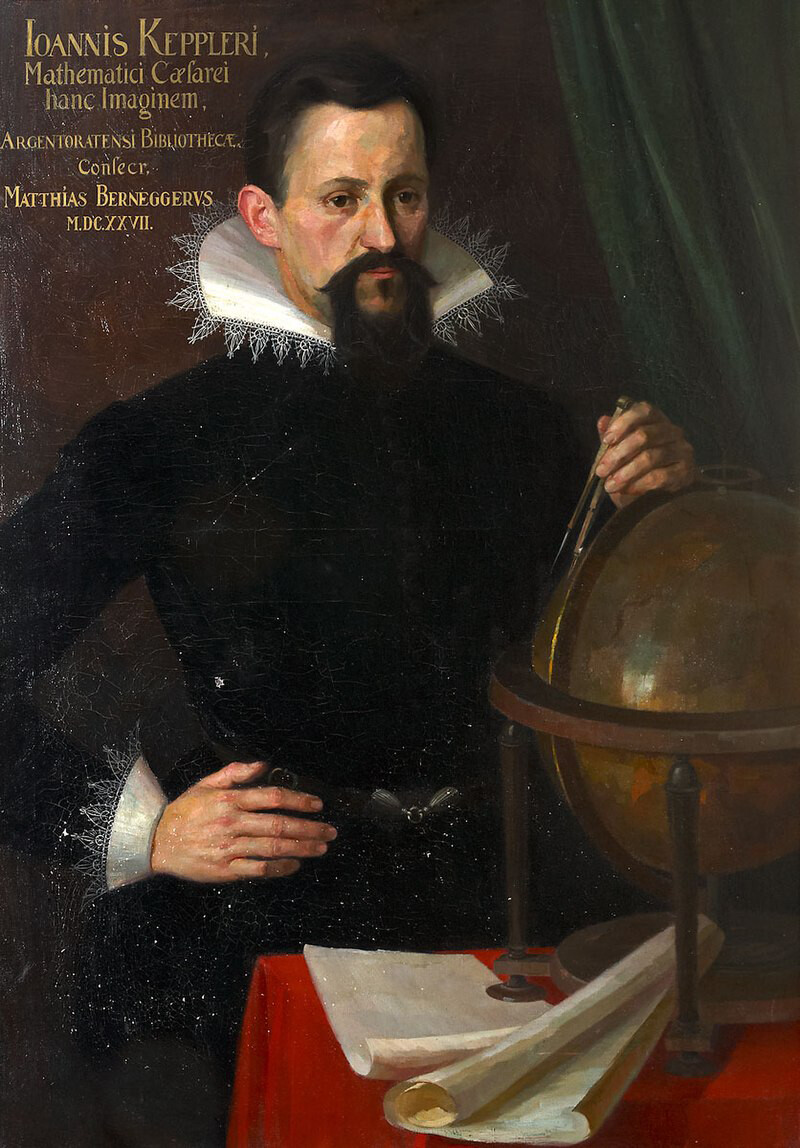
When discussing the giants of space science, names like Galileo or Isaac Newton usually dominate the conversation. However, if you look closer at the history of astronomy, I believe the most compelling story belongs to the 17th-century German astronomer Johannes Kepler. Facing severe physical disabilities, family chaos, and a scientific community that refused to change, he overcame every obstacle to fundamentally alter our understanding of the solar system. He is my favorite astronomer because he combined brilliant mathematical concepts with an unwavering commitment to the absolute truth.
Born in 1571 to a poor family, his dad abandoned him when Johannes was only five years old. He contracted smallpox as a kid, which permanently crippled his hands and left him with terrible eyesight. It is incredible to me to realize that one of the greatest observational breakthroughs in scientific history was made by a man who could barely see the night sky clearly.
Despite these challenges, math came naturally to him. As a child, he helped out at his grandfather’s inn, where customers were constantly blown away by how fast he could solve complex math problems in his head. Eventually, a new school system allowed him to attend a monastic school called Maulbronn Monastery. His teachers quickly realized he was far too talented for a normal trade and encouraged him toward higher education and science.
What really defines Johannes Kepler is when he got a job worki
ng for Tycho Brahe, a wealthy and eccentric astronomer who possessed the most accurate stargazing data in the world for his time. Brahe gave Kepler a notoriously difficult assignment: figure out the exact orbit of Mars. At the time, Mars was famous for not following standard predictions, and Kepler literally referred to this long, grueling project as his “war on Mars.”
For thousands of years, every major thinker assumed that planets moved in perfect circles. Kepler tried to prove this, too. In fact, he actually calculated a circle-based model that was 99.9% correct. It was only off by a tiny fraction. Most astronomers of his era would have accepted that as “good enough” and taken the credit. But Kepler possessed immense scientific honesty. He trusted Brahe’s data too much to accept even a minor error. In a bold move, he threw away his own life’s work and started over from scratch. That stubbornness paid off when he finally discovered the truth: planets do not move in circles. They move in ellipses, or ovals.
One of the most unique things about Kepler is how he wrote his masterpiece, Astronomia nova (New Astronomy) in 1609. Instead of just printing his final answers to look like a genius, he wrote the book like a diary. He left in every single mistake, every wrong turn, and every failed equation. He did not hide his struggles but boldly showed them to the world. I really like this specifically because despite his assumed genius, it shows that even the smartest people in the world can make mistakes.
He also invented the whole field of “celestial physics.” Before Kepler, astronomers just drew maps of the sky like it was a geometry class. Kepler was the first to ask why the planets were moving. He argued that a physical force had to be pushing them, and he even correctly guessed that the Sun was using a magnetic-like physical force to pull the planets along.
Unfortunately, Kepler’s life never truly became easy. He dealt with constant financial problems, faced excommunication from his church over religious disagreements, and even had to pause his research to defend his own mother in court when she was accused of witchcraft.
Yet, no matter how chaotic his life became, he never lost his love for the cosmos. He once beautifully wrote that the treasures hidden in the heavens are so rich that the human mind will never run out of fresh nourishment.
Johannes Kepler did not just fix the map of the solar system. He showed the world what a true scientist looks like, someone who cares more about the truth than being right, and someone who never loses their sense of wonder. That is why he stands out as the ultimate hero of astronomy in my opinion.
SOURCES
https://www.lindahall.org/about/news/scientist-of-the-day/johannes-kepler-4/
https://www.kloster-maulbronn.de/en/interesting-amusing/figures/johannes-kepler
https://mathshistory.st-andrews.ac.uk/Biographies/Kepler/