
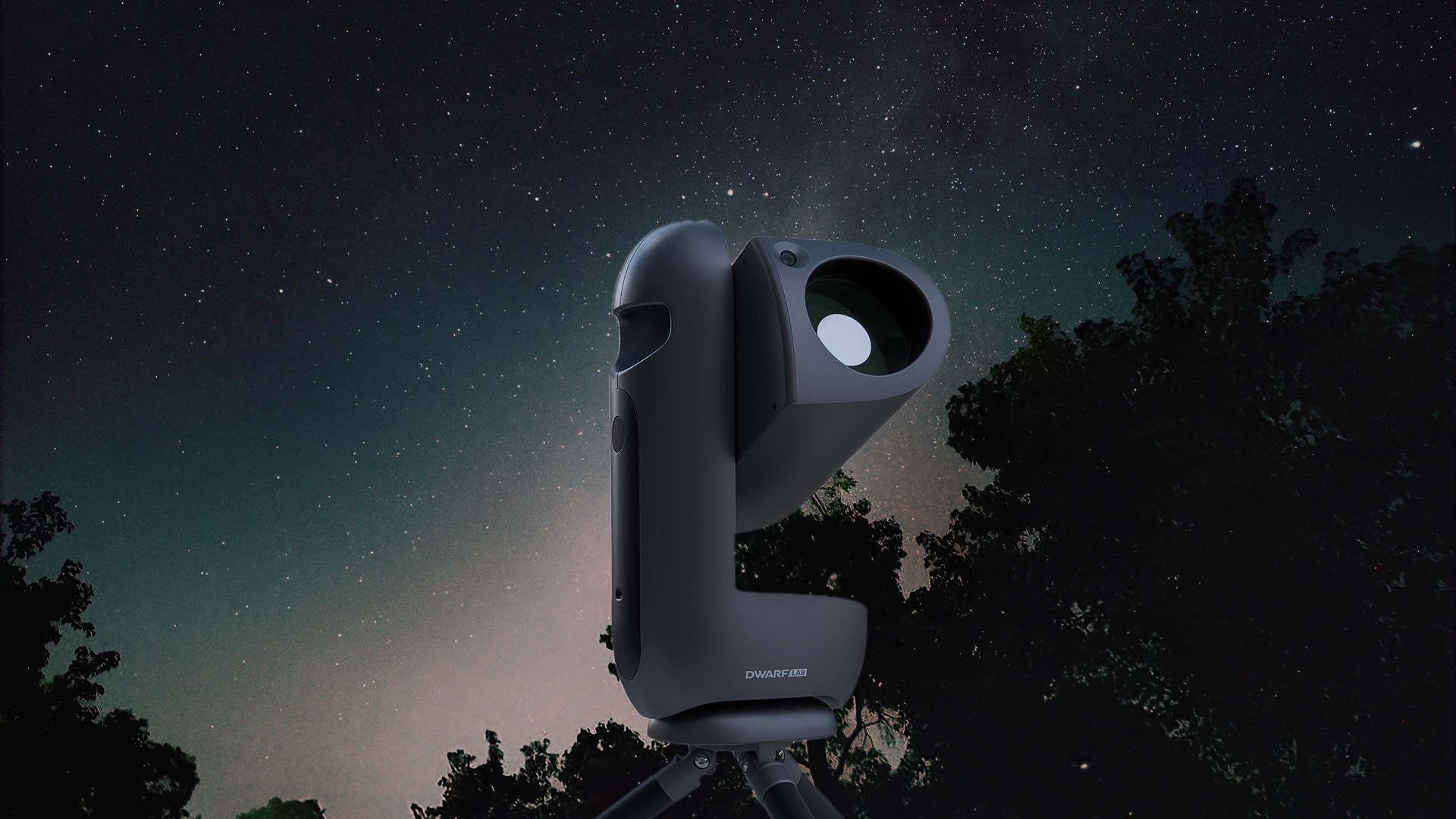
DWARFLAB recently donated a DWARF Mini smart telescope to the San Mateo County Astronomical Society. Recently the company sent us detailed information about Draco, its much larger new smart telescope, which is now available for preorder.
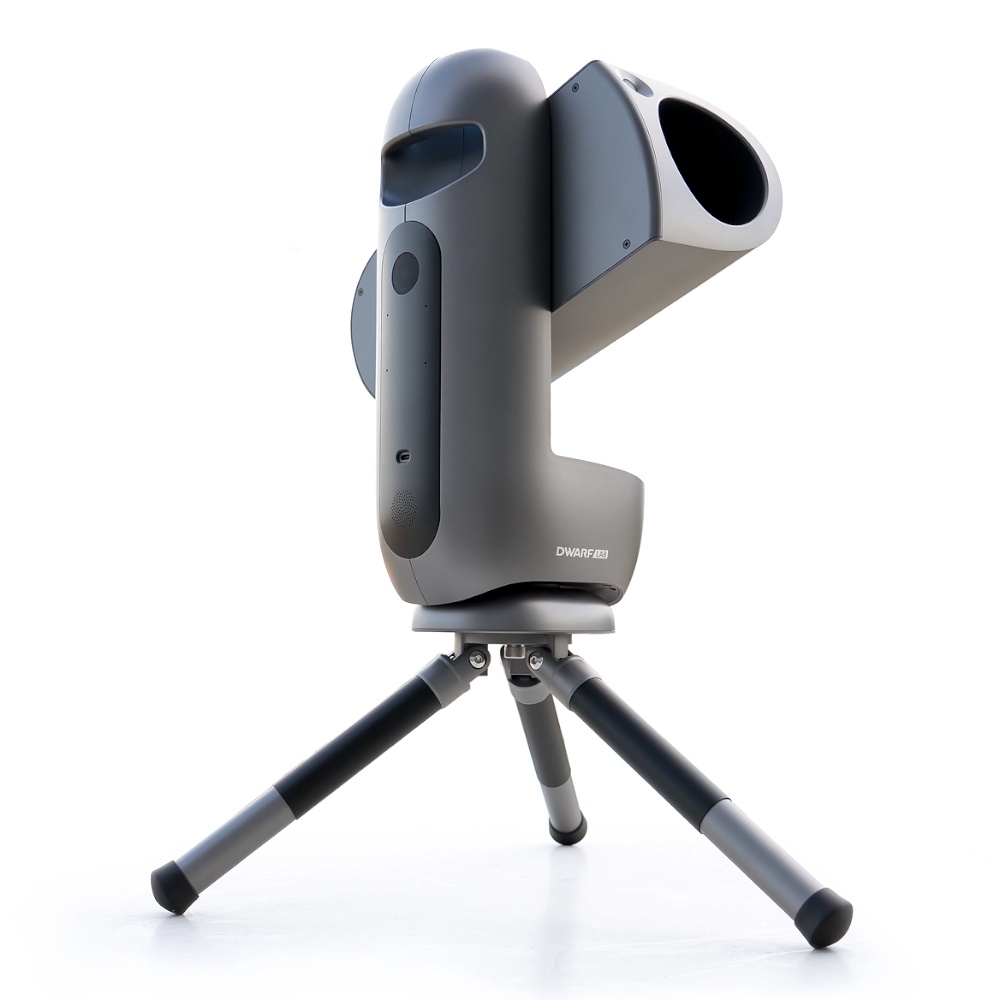
I have not yet seen Draco in action, so this is a preview rather than a hands-on review. Its announced specifications, however, show how quickly smart telescopes are developing—and how much astrophotography equipment can now be packed into one portable system.
From Smart Telescope to Portable Observatory
Smart telescopes combine optics, cameras, computerized tracking, image stacking, and processing software in one automated instrument. Instead of searching manually for an object, users select a target in an app. The telescope locates it, focuses, tracks it, takes a series of exposures, and gradually builds an image.
Draco follows this familiar approach, but its hardware is a significant step beyond DWARFLAB’s earlier telescopes. It has a 90 mm aperture, a 340 mm focal length, and a fast f/3.8 optical system. For comparison, the DWARF 3 has a 35 mm aperture and a 150 mm focal length.
Aperture is not everything, but a 90 mm opening has approximately 6.6 times the light-collecting area of a 35 mm opening. That should give Draco considerably more potential for recording faint nebulae, galaxies, and other deep-sky objects.
The telescope weighs approximately 12.1 pounds and includes a compact tripod. It is certainly portable, although at 5.5 kilograms, it is less “put it in your coat pocket” and more “give it a respectable place in the car.”
Three Cameras Working Together
Draco contains three separate cameras. Its main telephoto camera uses a 50-megapixel, 1/1.3-inch sensor. For deep-sky imaging, it combines groups of four pixels through 2×2 binning, producing images of approximately 12 megapixels with improved low-light sensitivity.
A second 50-megapixel wide-angle camera can photograph the Milky Way, star trails, landscapes, and large areas of the night sky. A third 4-megapixel monochrome guide camera monitors the stars and helps the telescope correct tracking errors during an exposure.
The main camera covers a field of approximately 1.65 by 1.24 degrees in astronomy mode. Draco can also create automatic mosaics, expanding the field to photograph objects that do not fit within a single frame.
Five-Minute Exposures Without Polar Alignment
Perhaps Draco’s most unusual feature is its physically rotating image sensor.
An alt-azimuth telescope can follow an object across the sky, but the field of view slowly rotates during a long exposure. Traditional astrophotographers usually solve this problem with an equatorial mount that must be carefully aligned with Earth’s rotational axis.
Draco takes a different approach. Its guide camera corrects tracking errors while the main CMOS sensor physically rotates to compensate for field rotation. DWARFLAB says this allows individual exposures of up to 300 seconds without requiring traditional polar alignment.
If it performs reliably, this could make longer-exposure astrophotography considerably more approachable. It is also one of the features I would most like to see independently tested once production telescopes reach users.
Cooling—and an Ingenious Use for the Heat
Long exposures cause electronic sensors to warm up, increasing noise in an image. Draco therefore includes active sensor cooling and heat dissipation.
DWARFLAB says the system redirects some of that heat toward the optics to help prevent dew from forming. In other words, one part of the telescope’s thermal problem may become part of the solution to another. The company has not yet published a specific cooling figure, such as how many degrees below the surrounding temperature the sensor can operate, so its real-world cooling performance remains to be seen.
Filters for Nebulae, Galaxies, and the Sun
Draco will be offered in Standard and SHO editions. Both include an astronomy filter for broad-spectrum targets such as galaxies and star clusters, as well as a dual-narrowband filter centered on hydrogen-alpha and doubly ionized oxygen. This filter can improve images of emission nebulae, particularly under light-polluted skies.
The Standard Edition also has a built-in neutral-density solar filter that can be moved into place through the app.
The more expensive SHO Edition replaces that internal solar filter with an additional sulfur-II and oxygen-III filter. By alternating between its two dual-band filters, Draco can collect sulfur, hydrogen, and oxygen data and automatically produce images in the blue-and-gold palette made famous by Hubble images. The SHO Edition includes an external magnetic solar filter instead.
Although Draco automates this process, its color camera and dual-band filters are not identical to the separate monochrome camera and individual filters used in a traditional SHO imaging system. The results will be interesting to compare.
As always, solar imaging should only be attempted with the correct solar filter securely installed.
Much of the Processing Is Automatic
The DWARFLAB app is designed to handle target acquisition, focusing, tracking, guiding, filter selection, calibration, stacking, mosaics, and image processing. It can automatically capture dark frames and apply flat, bias, and dark-frame calibration during live stacking.
The app also offers noise reduction, star correction, star reduction, star removal, and automatic Hubble Palette processing. More experienced imagers can export FITS and TIFF files for processing in their preferred astronomy software.
Draco includes 128 GB of internal storage, a 10,000 mAh battery, USB-C connectivity, Wi-Fi, Bluetooth, and NFC. DWARFLAB estimates a battery life of up to five hours, although cooling, long exposures, temperature, and other operating conditions will likely affect that figure.
Remote control and scheduled imaging are also planned. Users will be able to program a target and observing time, allowing Draco to wake up, locate the object, and begin imaging automatically. Apparently, the telescope is prepared to stay up later than many of us are.
Price and Availability
As of September 2026, Draco is available for preorder in two configurations:
- Standard Edition: $1,399
- SHO Edition: $1,599
DWARFLAB has also provided SMCAS members with an exclusive discount code. SMCAS members who are interested in ordering a Draco may contact the club to request it if you don’t have it already.
DWARFLAB currently estimates that preorders will ship within three months of the order date. The package includes the telescope, tripod, carrying case, USB-C cable, and cleaning cloth. The SHO package also includes its external solar filter.
A Promising Preview
Draco is not inexpensive, but its price should be considered in relation to everything integrated into the system: telescope, automated mount, three cameras, guiding, cooling, physical field derotation, filters, battery, computer, and processing software.
Its published specifications are impressive, but specifications and manufacturer-supplied images cannot replace experience beneath the stars. The important questions will be how accurately its guiding and rotating sensor work, how effective its cooling is, and how well the app manages long unattended imaging sessions.
For now, Draco offers an intriguing look at where smart telescopes may be heading. They began by making basic astrophotography easier. Instruments such as Draco are now attempting to combine that accessibility with capabilities once associated with much more complicated imaging rigs.
And while it may automate polar alignment, guiding, calibration, stacking, and processing, there is still one traditional astronomy problem it cannot solve: clouds.
More information is available on the official Draco product page, the Draco preorder page, and the technical specification sheet supplied by DWARFLAB.