
Object: Sculptor Galaxy or NGC 253
Photographer: Michael Cooke
Camera: eVscope V1
Location: San Mateo, CA
The galaxy was discovered by Caroline Herschel in 1783.
Object: Sculptor Galaxy or NGC 253
Photographer: Michael Cooke
Camera: eVscope V1
Location: San Mateo, CA
The galaxy was discovered by Caroline Herschel in 1783.
Greetings to the Society,
As we venture into March and April 2025, the cosmos offers a plethora of captivating events and milestones for astronomy enthusiasts and space aficionados. From celestial phenomena gracing our night skies to groundbreaking space missions, here’s what to anticipate in the coming months.
Right off the bat planets galore, skywatchers are treated to a rare celestial event: a planetary alignment featuring seven planets—Mercury, Venus, Mars, Jupiter, Saturn, Uranus, and Neptune—visible in the evening sky. This phenomenon, often termed a “planetary parade,” offers a unique opportunity to observe multiple planets simultaneously.
Firefly Aerospace‘s Blue Ghost lunar lander is scheduled to land in the Mare Crisium region of the moon on March 2, 2025. On the heels of Firefly Aerospace’s moon landing attempt, another commercial space company Intuitive Machines will try to touch down just four days later on March 6th.
A mesmerizing total lunar eclipse, often referred to as a “blood moon,” will be visible on March 13 at 8:57 p.m. PST, reaching totality at 11:26 p.m. PST, and lasting over an hour. During totality, the moon will acquire a reddish hue due to Earth’s shadow. No special equipment is required to observe this phenomenon, though binoculars or a telescope can enhance the experience.
On March 29, 2025 there will be a partial solar eclipse but unfortunately it will only be visible in northeastern North America. But that same night starts the Messier Marathon is an annual event where astronomers attempt to observe all 110 Messier objects in a single night.
Mid-April brings another delightful planetary alignment featuring Mercury, Venus, Mars, and Saturn. These planets will appear clustered in the early morning sky, offering a splendid view for early risers.
And just in time for my birthday the Lyrid meteor shower will be active from April 17 to 26. Lyrid meteor shower originates from comet Thatcher. Each time a comet zips through the inner solar system, the sun boils off some of its surface, leaving behind a trail of debris. When the Earth intersects with the old comet detritus, we get a meteor shower.
NASA’s Lucy spacecraft is scheduled to perform a flyby of asteroid 52246 Donaldjohanson on April 20. This encounter marks Lucy’s first close examination in its mission to study Jupiter’s Trojan asteroids.
As we set our sights on the starry expanse, let’s cross our fingers for cloudless nights to amplify our encounters with the universe’s greatest show.
Clear skies and happy viewing!
Michael Cooke
President, San Mateo County Astronomical Society
Actually, I have lots of astronomers I admire but I’m going to talk about one who interests truly mirror my own, Sir William Herschel.
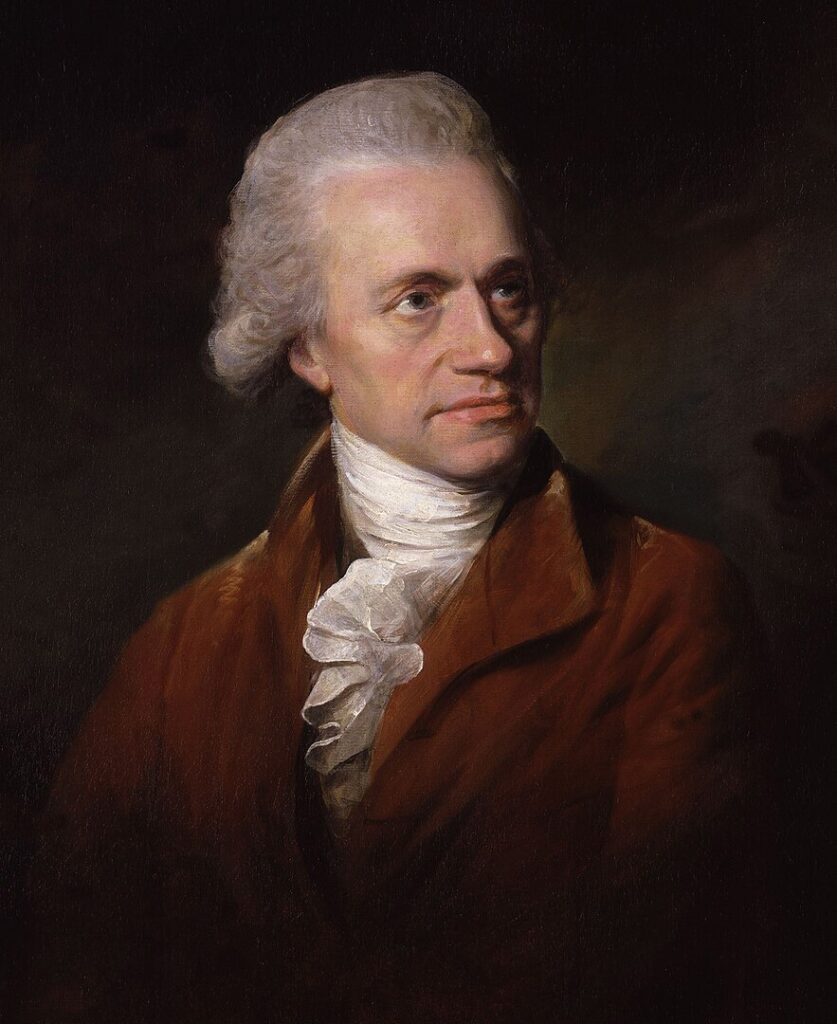
Born Friedrich Wilhelm Herschel on November 15, 1738, in Hanover, Germany, Herschel was immersed in music from an early age. His father, Isaak Herschel, an oboist in the Hanover Military Band, instilled in him a profound appreciation for the art. Demonstrating prodigious talent, young William mastered multiple instruments. Herschel was a contemporary of Haydn, Mozart, and Beethoven—he embarked on a musical career that saw him composing and performing across Europe.
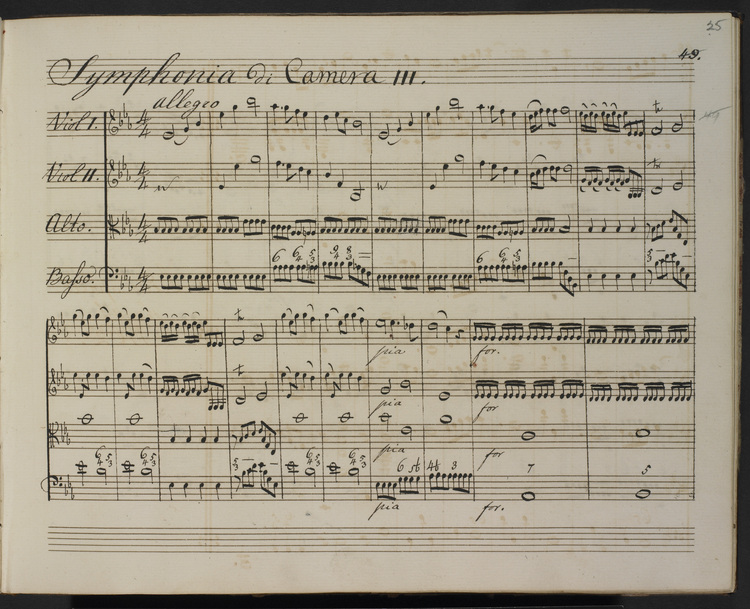
In 1757, amidst the turmoil of the Seven Years’ War, Herschel relocated to England, seeking refuge and new opportunities. There, he initially sustained himself by copying music and offering private lessons. His exceptional skills did not go unnoticed; by 1766, he secured the prestigious position of organist at the Octagon Chapel in Bath, a city celebrated for its cultural and musical vibrancy. Beyond his organist duties, Herschel became the Director of Public Concerts, where he frequently showcased his compositions. His oeuvre includes 24 symphonies, numerous concertos for oboe, violin, viola, and organ, as well as various chamber and sacred works. Notably, his Symphony No. 14 in D major, composed in 1762, exemplifies his adeptness in orchestral writing.
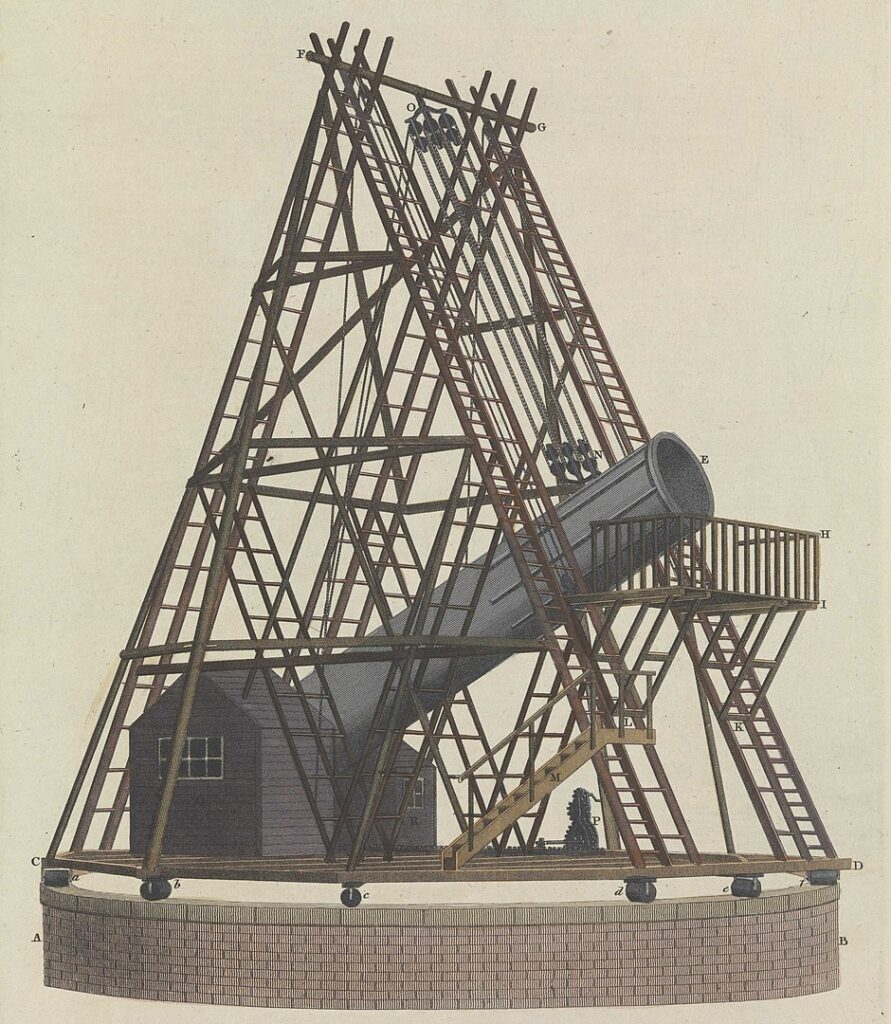
While music was his livelihood, the mysteries of the cosmos beckoned Herschel with an irresistible allure. His interest in the mathematical aspects of music led him to delve into works on harmonics and optics. This academic pursuit sparked his fascination with telescope construction and celestial observation. By 1773, he had begun building his own telescopes and conducting nightly observations.
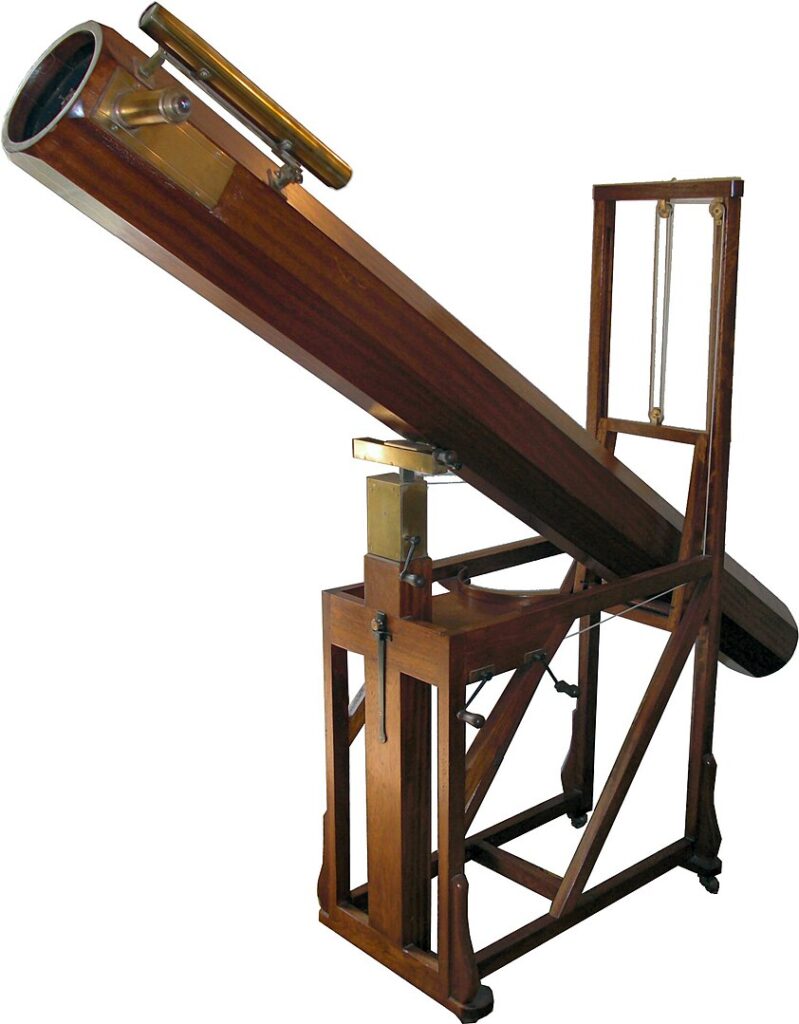
The pinnacle of Herschel’s astronomical career came on March 13, 1781, when he identified a new celestial object. Initially believing it to be a comet, further observations revealed it as a new planet, which he called “Georgian star” (Georgium sidus), but was later named Uranus. This groundbreaking discovery expanded the known boundaries of the solar system and earned Herschel international acclaim. In recognition, King George III appointed him as the King’s Astronomer, providing him the means to abandon his musical career and devote himself entirely to astronomy.
In 1787, he discovered two of Uranus’s moons, Titania and Oberon, further expanding our understanding of planetary systems. His keen observations also led to the identification of two additional moons of Saturn, Mimas and Enceladus, in 1789. These discoveries were monumental, as they unveiled celestial bodies previously unknown to humanity.
Herschel’s curiosity wasn’t confined to our solar system. He conducted extensive surveys of the night sky, cataloging over 2,500 nebulae and star clusters. His meticulous work culminated in the “Catalogue of Nebulae and Clusters of Stars,” which remained a cornerstone reference for astronomers. Through his studies of double stars, Herschel provided empirical evidence that many such pairs are gravitationally bound, offering early insights into stellar dynamics.
In a groundbreaking experiment in 1800, Herschel discovered infrared radiation. By passing sunlight through a prism and measuring the temperature just beyond the visible red spectrum, he detected a form of light invisible to the human eye but perceptible as heat. This revelation expanded the known electromagnetic spectrum and opened new avenues in the study of light and energy.
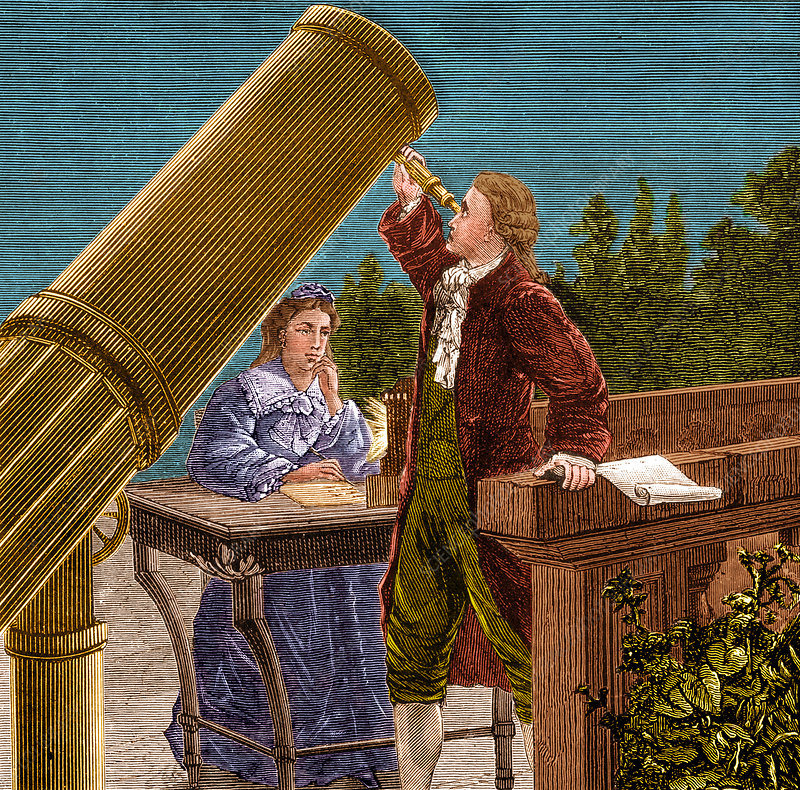
Central to his success was his sister, Caroline Herschel, whose own remarkable contributions have earned her a distinguished place in the annals of science. Caroline’s journey into astronomy began as an assistant to her brother, but she soon emerged as a formidable astronomer in her own right. Between 1786 and 1797, she discovered eight comets, with her first, Comet C/1786 P1, identified on August 1, 1786. This achievement marked the first recorded discovery of a comet by a woman. Her diligent sweeps of the sky also led to the identification of 14 new nebulae and the independent discovery of Messier 110, a companion galaxy to the Andromeda Galaxy.
Today, Herschel’s dual legacy endures. His musical compositions, though overshadowed by his astronomical achievements, offer insight into the rich musical landscape of 18th-century England. Recordings of his symphonies and concertos have been revived, allowing contemporary audiences to appreciate his artistic prowess. Simultaneously, his astronomical discoveries laid the foundation for modern observational astronomy, inspiring generations of stargazers to look beyond the known and explore the vastness of the universe.
Personally inspiring, William Herschel’s life exemplifies the harmonious fusion of art and science, illustrating how diverse passions can converge to yield extraordinary contributions to human knowledge and culture.
Speaker: Dr. Pascal Lee, Planetary Scientist
SETI Institute, Mars Institute, and
NASA Ames Research Center
The Moon & Mars: Amazing Places for Humans to Soon Explore, Part 1: the Moon!
Free and open to the public. At the College of San Mateo Planetarium. Free Parking in nearby lots eg Lot S (5) or Lot R. Click here for Google map/directions
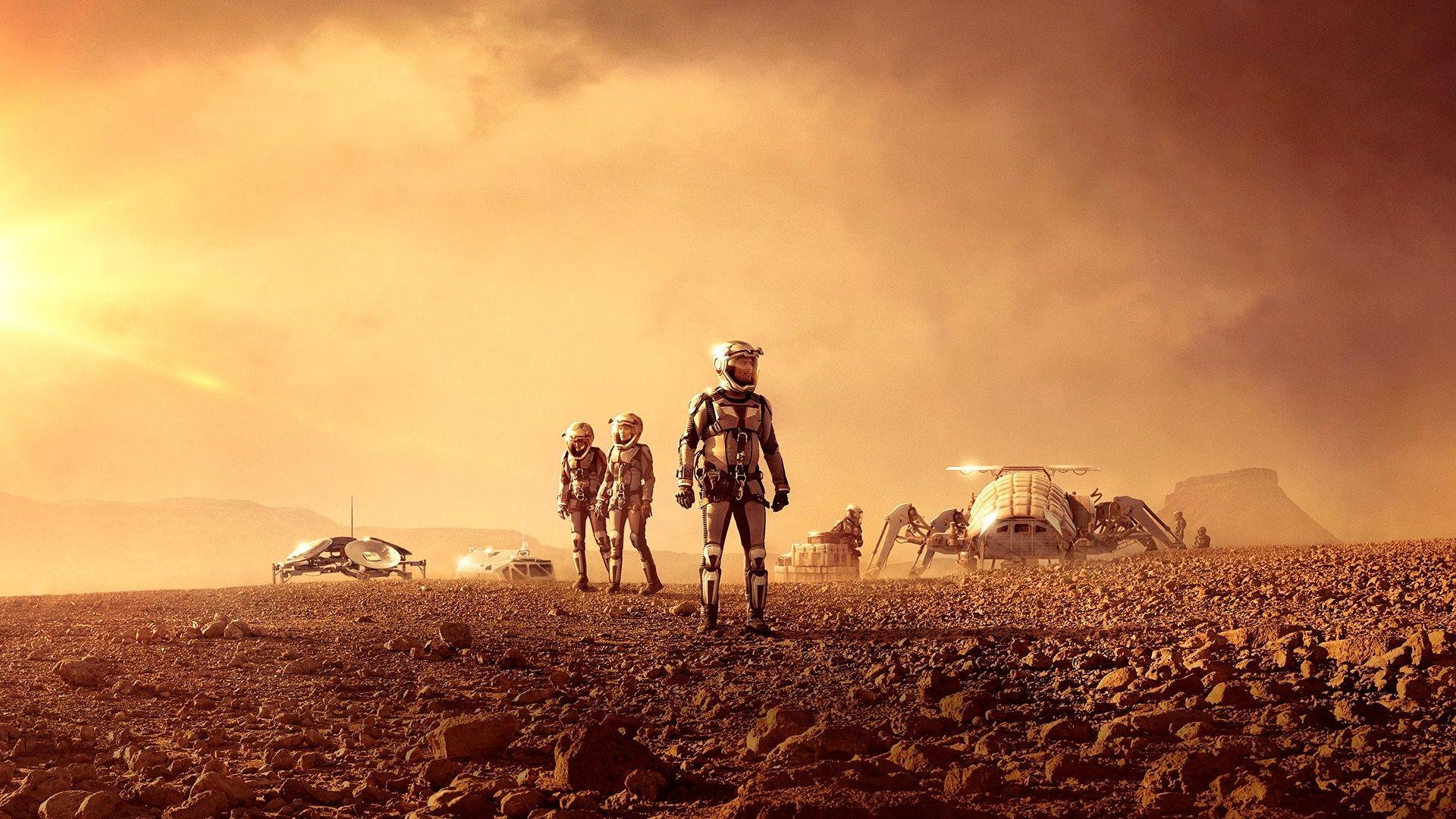
The Moon and Mars are humanity’s destinations in space this century. Why and how will we explore these worlds? When will we go? Where will we land, what will we see, and what will we do? And who will go?
Dr. Pascal Lee is a leading planetary scientist working on planning the future human exploration of the Moon and Mars. In this Part 1 of his talk, he will guide us through current and emerging new plans to return to the Moon, the challenges we face, the wonderful opportunities ahead, and the amazing places humans will soon explore. In Part 2: Mars! at our May meeting he will cover the journey to Mars.
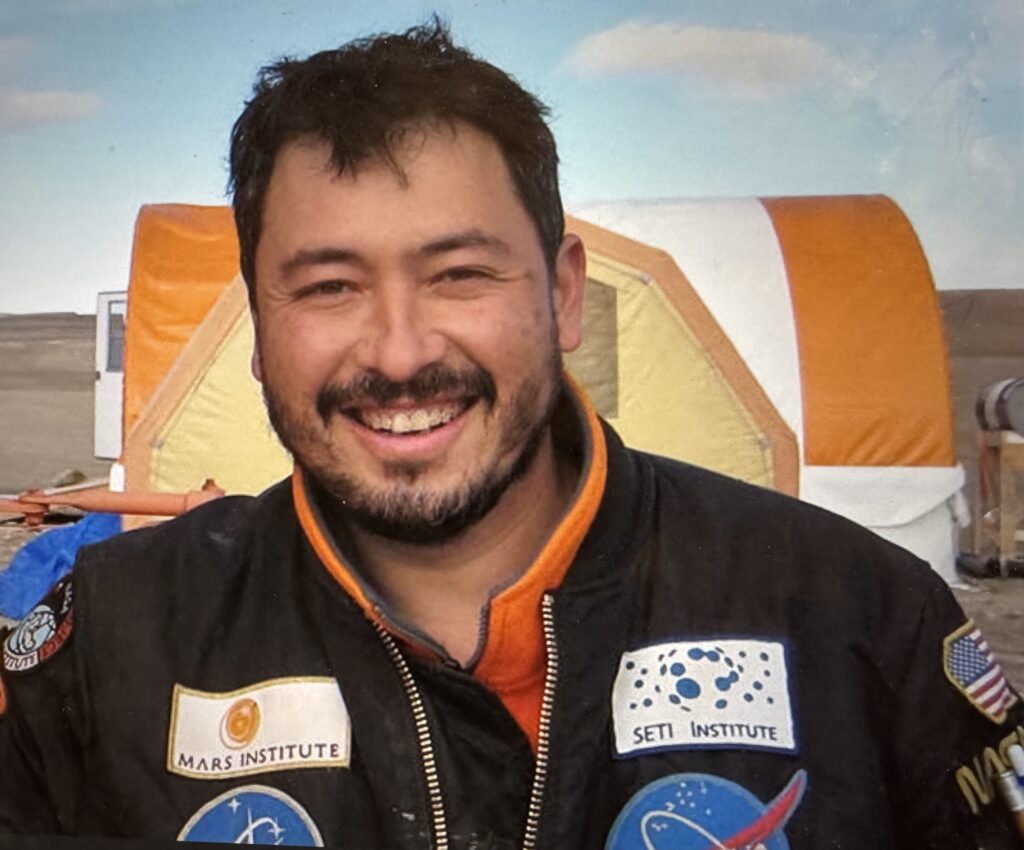
Dr. Pascal Lee is a planetary scientist affiliated with the SETI Institute, the Mars Institute, and NASA Ames Research Center in Mountain View, California. He also holds the position of professor of planetary sciences at Kepler Space University.
Dr. Lee earned an M.E. in geology from the University of Paris-Sorbonne and an M.S. and Ph.D. in astronomy and space sciences from Cornell University, where he served as Carl Sagan’s last teaching assistant. His research focuses on the Moon and Mars, with a particular emphasis on planning future human exploration of these celestial bodies. Earlier this year, he made a significant announcement about the discovery of an ancient giant volcano on Mars, known as Noctis Volcano, which generated worldwide excitement.
Dr. Lee has led over 30 expeditions to the Arctic and Antarctica to study Mars through Earth-based analogs. He spent 402 days wintering over at an Antarctic base and also led the Northwest Passage Drive Expedition, an epic rover drive across the Arctic along the fabled Northwest Passage.
Dr. Lee is currently a member of the U.S. National Academies’ steering committee on “A Science Strategy for the Human Exploration of Mars.” He is the recipient of several honors, including the United States Antarctica Service Medal, the National Space Society Space Pioneer Award for Science and Engineering, the Space Frontier Foundation’s Vision to Reality Award, and the Sagan Prize for the Popularization of Science.
Pascal Lee enjoys flying and painting (but not at the same time). He is an FAA-certified helicopter commercial pilot and flight instructor, and an artist member of the International Association of Astronomical Artists (IAAA). He lives in Santa Clara, CA, where he is walked daily by his Australian Cattle Dog, King Kong, son of Ping Pong.
DIRECTIONS
Visitors to the presentation are also invited to join our SMCAS members at our pizza social (free pizza and soda drinks) prior to the presentation starting at 7:00 pm in nearby Building 36 room 110 (Building 36 is the building the Planetarium is attached to). We will move to the Planetarium shortly before 8:00 pm. Note that the Planetarium may remain closed until shortly before 8:00 pm.
The College of Mateo (CSM) general address is 1700 W Hillsdale Blvd, San Mateo, CA. It is off the Hillsdale Blvd exit from HW 92 in San Mateo. Proceed north on Hillsdale Blvd to where it turns into Perimeter Road, which will take you to the Planetarium and Building 36 Parking lots. Better directions can be generated from the Google Maps Directions feature when accessing the Planetarium location on Google maps. (click here). Parking is free in the well lighted lots near the Planetarium: Staff lat S (sometimes shown as Marie Curie Lot 5), Lot R (Staff and Visitor), or other nearby lots such as Q if Lots S and R are full. A more detailed map of the CSM campus can also be found on the CSM website here.
Most astronomers know about Stellarium; it is a fantastic tool for exploring
what the night skies will be like. It is also a really good planning tool for
astrophotography.
During one of the star parties at Crestview Park last summer, I wanted to take
some photos of the North America Nebula. After at least an hour of setting up,
focusing, and polar aligning my telescope, I slewed to where the North America
Nebula would be … only to notice it was perfectly hidden behind the giant
tree in the middle of the roundabout. I had checked it in stellarium before
leaving home, but had forgotten about the tree. After all the time setting up,
I did not want to re-align just to move the whole setup 5 meters to the side.
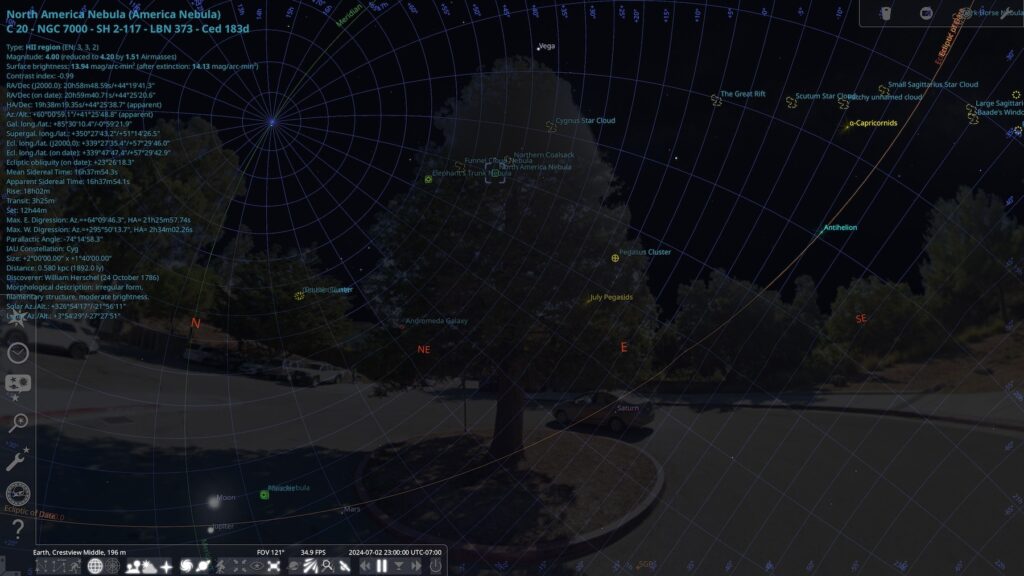
Here is a custom landscape in Stellarium to show three different locations in
Crestview Park, hopefully this helps other people when planning for our star
parties. The easy way to install it is to open Stellarium, open the “Sky and
viewing options window” on the left. Click on the “Landscape” tab at the top,
then click the “Add/Remove Landscapes …” button, and select the path to the
zip file. Stellarium will handle unzipping and putting the files in the correct
location. To manually install on linux, unzip so the structure is~/.stellarium/landscapes/crestview-left_tables/landscape.ini
In this zip file, the landscapes were saved from Google Street View and then
edited to what is needed for Stellarium. The first is near the picnic tables on
the left, another is in the middle of parking on the right, and last is right
in the middle.
To make a Stellarium landscape of somewhere else, the first part is getting a
good panorama. For Crestview Park, I used this Chrome extension
to fetch a spherical panorama from Street View. For making a landscape for my
backyard, I used the Photo-sphere mode on my Pixel phone. Stellarium needs to
have a full spherical panorama (ie, covering zenith and nadir, not only 360
degrees around azimuth).
The panorama needs to be in PNG format with a transparent sky. The size must be
2:1, and for best compatibility with most graphics cards, I’d suggest
powers-of-2, 4096×2048 works well for me. The horizon line must be half-way
down the image and completely horizontal. This was automatically correct when I
used the photo-sphere mode on my phone. For the best quality panoramas, you
should rotate the camera around the camera lens, don’t keep your feet in place
and swing your hands in front of you. When I took the photo sphere of my back
yard, I held the phone at the exact height/location where I set up my camera
tripod.
Aligning north in the panorama is more complicated. Find a mark that is
pointing exactly in one of the cardinal directions, it will be needed later to
align things.
After all this, your panorama should look something like this when you open it
in a standard image viewer.
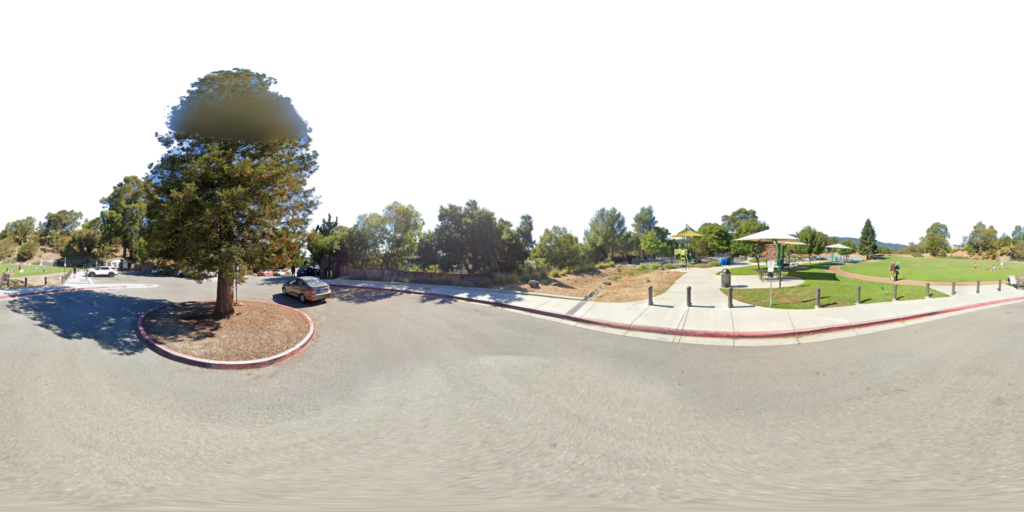
To make the panorama work in Stellarium, the sky needs to be transparent. Open
the image in GIMP or Photoshop and make sure to add an alpha channel to the
image if it does not already have one.
The best way to remove the sky from the image is with the fuzzy-select tool.
Play with the threshold value to find a good value that works for your image.
Once most of the sky is selected, hit the delete key to make the sky
transparent. I found that using “Select by: Blue Channel” worked well for my image,
too.
Once the sky is transparent, export the image in PNG format (jpeg does not
support transparancy). Put the image in a new empty directory.
After editing, you should end up with a file that looks something like this:
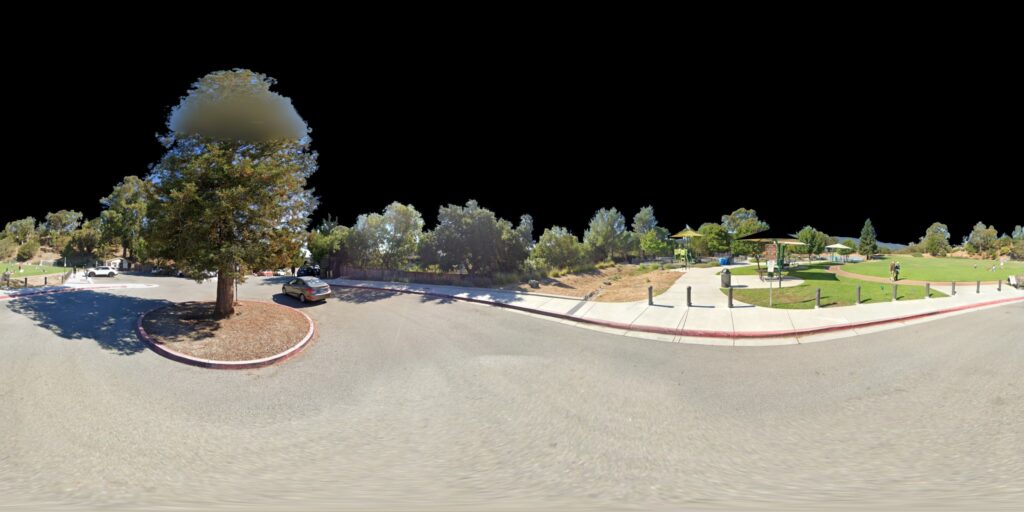
Alongside the image, Stellarium needs a landscape.ini file in the directory next to the image. Here are the contents for the crestview landscape. Save this to landscape.ini in the same directory with the image.
[landscape]
name = Crestview Left Tables
author = Jason Zaman
description = Crestview Park SMCAS star party location. From google street view near tables on the left
type = spherical
maptex = crestview-left_tables.png
angle_rotatez = 203
; Do maths for the angle_rotatez value:
; angle_rotatez = 270 + degrees - (360 * pixels / image_width)
; degrees = the value of which ever cardinal point you choose in Photoshop; N=0, E=90, S=180, W=270
; pixels = is what you read off the top ruler in Photoshop at the cardinal point
; north ~= 380 pixels
; >>> 270 + 0 - (360 * 380 / 2048)
; 203.203125

[location]
light_pollution = 5
planet = Earth
latitude = +37d29'2.5872"
longitude = -122d17'5.6652"
altitude = 196
timezone = America/Los_Angeles
Lines starting with a semicolon are comments and are ignored.
The maptex = line should be the filename of the image exported earlier. Fill in name/description as you like.
The angle_rotatez = line is how we adjust the alignment between the image and the north.
Find a mark in the image that is lined up with a cardinal direction. Read off the horizontal coordinate in the image of that mark and it will be pixels in the formula. Then degrees depends on which cardinal direction:
North=0, East=90, South=180, West=270.
Compute angle_rotatez = 270 + degrees + (360 * pixels / image_width) and round to the nearest integer. For example, in the crestview image, north is 380 pixels from the left of the image, so angle_rotatez = 270 + 0 - (360 * 380 / 2048) = 203
Most of lines in the [location] section are optional, but are nice to have. If latitude/longitude are in the file, then Stellarium can automatically adjust the viewing location when switching landscapes.
the light_pollution= line is in the bortle scale. Altitude is in meters above sea-level.
Once both the image and the config file are done, zip both files up and add them in the Stellarium landscape UI.
A heads up from Ed Ching
For those who have been following the saga of the Optronic Techonologies, Inc., business, parent of both Orion Telescopes and Meade Instruments, the offices and storefront in Watsonville, California were shut down in July 2024. On July 31, the Orion website went offline.
Apparently the assets of Meade/Orion/Coronado are going up for auction starting January 6, 2025. Remains of Orion/Meade/Coronado Up For Auction – Cloudy Nights. Pickup only at Watsonville warehouse from January 9. Bundled lots, presumably intended for commercial resellers to bid on bundles.

One of my favorites sources for astronomy information is www.almanac.com. It’s also an excellent source for gardening and farming. They say that the best farmers and gardeners plant everything based on the moon phase, not the sun as most would think. They even have an activity guide where they recommend the best days to do certain things. Several have to do with living on a farm and tending to animals, others don’t. They post it monthly at https://www.almanac.com/bestdays/calendar. They even have a page dedicated to Health & Beauty, which if you haven’t guessed yet, it too is based on the phase of the moon. It can be found at https://www.almanac.com/best-days/health-and-beauty. If you purchase their book, you won’t have to wait for the monthly postings.
There are days when they recommend getting your hair cut to encourage growth. I recommend trying to follow those days. Is there anyone else that follows these calendars?
Greetings to the Society,
2024 was an incredible year for astronomical events. Many members experienced the awe-inspiring total solar eclipse on April 8, 2024, with some traveling to witness this rare celestial phenomenon firsthand. Closer to home, parts of the Bay Area were treated to a dazzling display of the Aurora Borealis or Northern Lights, as increased solar activity illuminated the sky with vibrant colors.
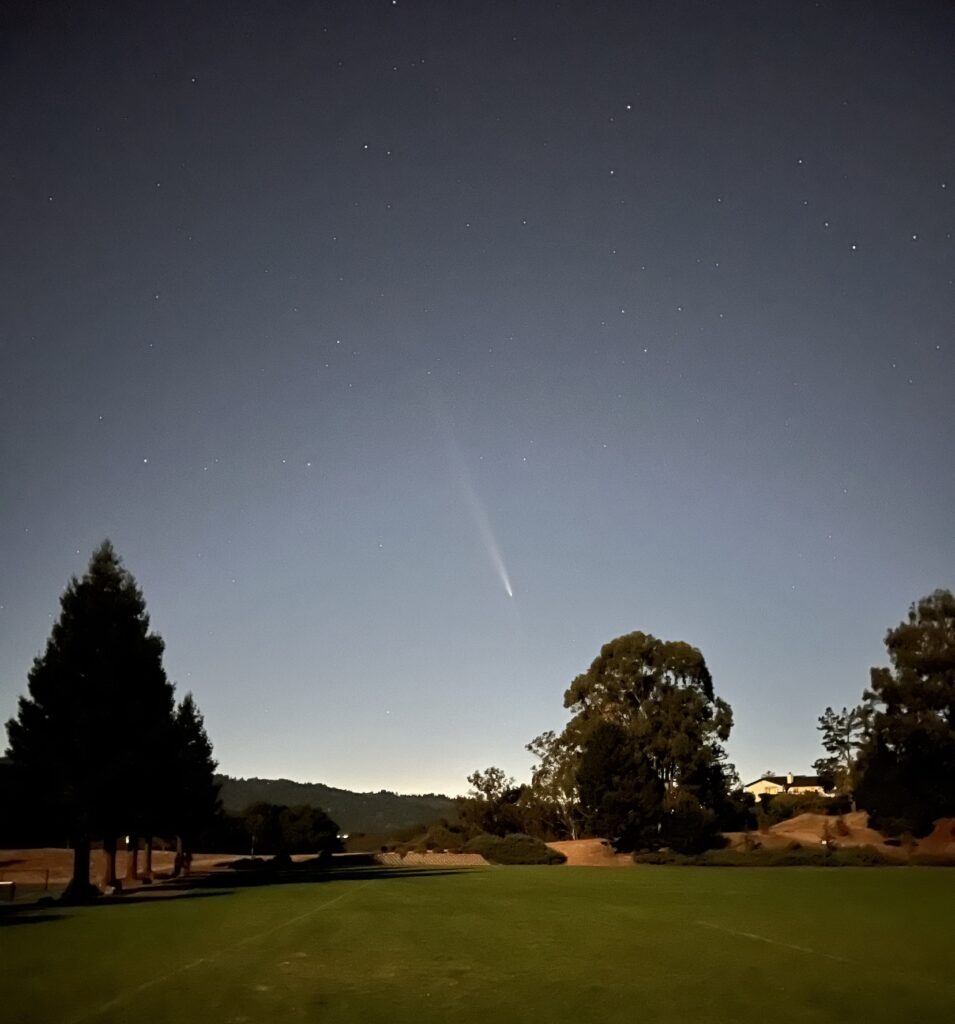
One of the year’s most exciting events was Comet C/2023 A3 (Tsuchinshan-ATLAS), which became visible to the naked eye. The comet delighted observers with its bright coma and a spectacularly long tail, creating unforgettable moments for skywatchers.
However, not every anticipated event occurred. We are still waiting for the much-anticipated nova event involving T Coronae Borealis (Blaze Star). Expected to erupt in 2024, the Blaze Star has remained quiet, leaving us hopeful that 2025 will bring this remarkable celestial event to fruition.
Early January provides a captivating display for stargazers and astrophotographers, beginning with a breathtaking alignment of the crescent Moon and Venus on January 3rd. Low in the western sky shortly after sunset, this pairing offers a stunning opportunity to capture the beauty of our celestial neighbors against a twilight backdrop.
The Moon continues its journey, drawing closer to Saturn by January 4th. This striking conjunction, visible around 5:00 PM PST, brings the two celestial bodies into remarkable proximity, creating a mesmerizing scene in the night sky. Observers worldwide can enjoy this pairing, with Saturn’s rings and the Moon’s craters offering a delightful target for telescopes and binoculars.
As the month progresses, the celestial drama intensifies with the arrival of the Wolf Moon on January 13th. This first full moon of 2025 brings a spectacular occultation of Mars. Observers in San Mateo can watch as Mars vanishes behind the Moon at 5:58 PM PST, reappearing about 50 minutes later—a truly unforgettable sight.
Adding to the excitement, comet C/2024 G3 (ATLAS) might grace the skies around the same time. As the comet approaches its closest point to Earth, it has the potential to become visible to the naked eye. While its brightness remains unpredictable, this celestial visitor offers another reason to keep your telescope at the ready and revel in January’s astronomical wonders.
In February 2025, NASA plans to launch the Spectro-Photometer for the History of the Universe, Epoch of Reionization and Ices Explorer, or SPHEREx, observatory. This mission will survey the sky in near-infrared light, which is a type of light that is invisible to the naked eye but that special instruments can detect. Near-infrared light is useful for observing objects that are too cool or too distant to be seen in visible light.
SPHEREx will create a comprehensive map of the universe by surveying and collecting data on more than 450 million galaxies along with over 100 million stars in the Milky Way. Astronomers will use this data to answer big questions about the origins of galaxies and the distribution of water and organic molecules in stellar nurseries – where stars are born from gas and dust.
Although there’s no meeting in January, don’t miss our Annual Holiday Party on January 18th, 2025! Details have been sent via email, so check your inbox for more information.
As we look ahead, let’s hope for clear skies to enhance our viewing of the many celestial wonders coming our way. Here’s to a year full of stargazing adventures and discoveries.
Clear skies and happy viewing!

Michael Cooke
President, San Mateo County Astronomical Society
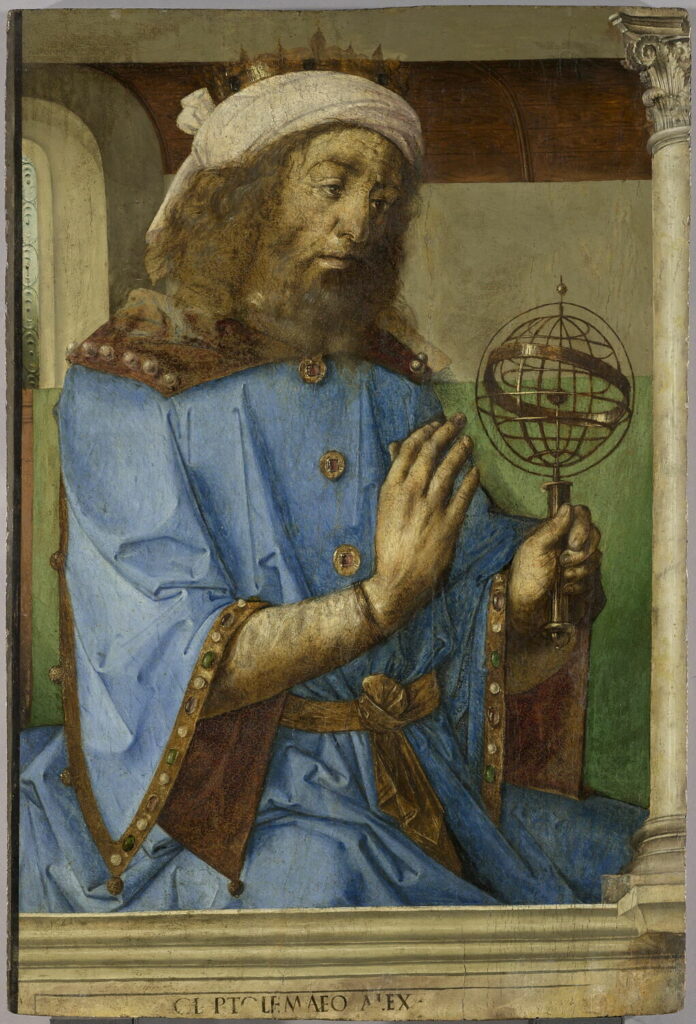
As someone who used to write an astronomy column for the San Mateo Daily Journal and a huge astronomy fan, I know most of the ancient astronomers but of course, not all. There was a name that kept reappearing in my research that I wasn’t familiar with. I’m not sure if he’s my favorite astronomer, but he’s definitely one I became fascinated with. That ancient astronomer is Claudius Ptolemy. Again, while I did constellation and star cluster research and most notably with the Messier objects, it was often noted that Ptolemy was the first to document the constellation or star object. This made me curious. Why would Ptolemy be credited for first documenting the heavenly body when they’re still called Messier Objects? That’s because Ptolemy was one of those astronomers who suggested that Earth was the center of our universe, not the sun. When it was proven his theories were wrong, most of his work was forgotten since most of it was either inaccurate or was proved to be inaccurate. On the other hand, he help to shape Messier’s list and was one of the first to suggest using longitudes and latitudes, just to name a couple.
Most would say, Ptolemy was born in 100 and died in 170; but not all, some suggest that he was born in 85 died in 150 or 165. It is agreed that he was Egyptian astronomer, mathematician and geographer of Greek descent who thrived in Alexandria between 127 and 145. Practically nothing is known about his life but his books give you a glimpse into his intelligence.
Ptolemy wrote many sets of books. He most known for the “Almagest” (from a hybrid of Arabic and Greek, meaning the greatest) but Ptolemy called it, “The Mathematical Collection,” because he believed that the motions of the heavenly bodies could be explained in mathematical terms. The Almagest is divided into 13 books, each of which deals with astronomical concepts concerning to stars and objects in the solar system.
It was actually another ancient Greek astronomer who first started a star list, Hipparchus. It’s estimated that he born 190 BC and died120 BC at the age of 70. He compiled the first star catalog that contained 850 stars. Ptolemy expanded the list in the Almagest by 172 stars, bringing the total to 1,022. Again, he believed the earth was the center of the universe. This became known as the Ptolemaic system but today is better known today as the geocentric model.
It would take 1400 years for another famous astronomer to prove Ptolemy wrong. It was Nicolaus Copernicus (February 19, 1473 —May 24, 1543) who proved the sun was the center of the universe. He too wrote a manuscript about it but it was printed after he died in 1543.
Another set of books Ptolemy wrote is called, the ”Geography.” In one of the volumes, he explains how to draw a world map by using longitude and latitude lines in one of the volumes. Since his map were proven to be inaccurate, he’s rarely given credit for being one of the first to explain how to make world maps.
Ptolemy even wrote on astrology and harmonics that would go to influence the Western world.
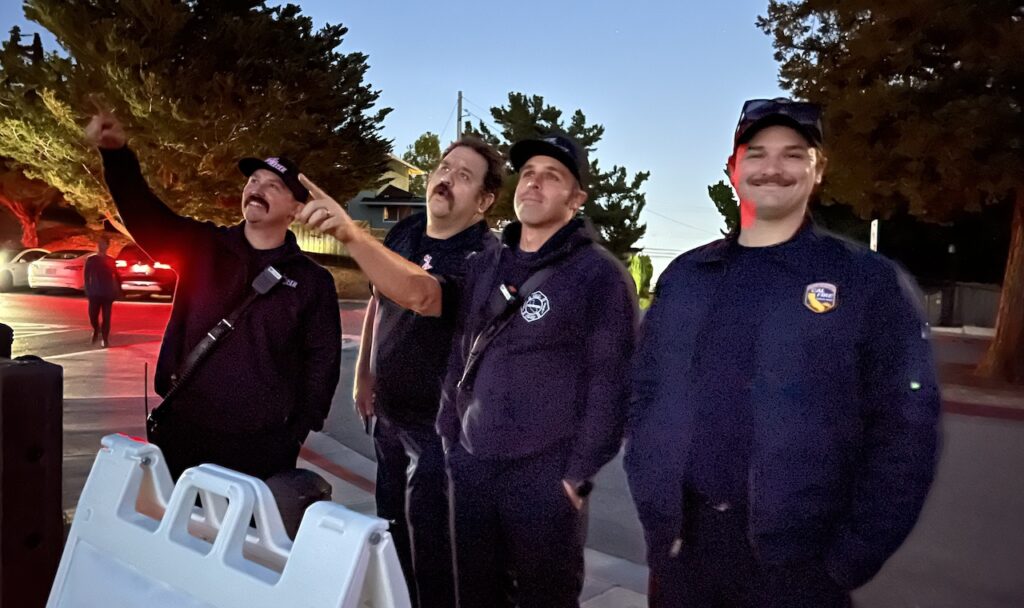
San Mateo County Fire Department employees from left to right are Firefighter Matt Hoffmann, Engineer John Hollander, Fire Capt. Jordan Motts and Fire Capt. Chris Schaefer.
If you’ve been keeping up on our newsletter, you might recall we had an unusually exciting Star Party July 3. The San Mateo County Fire Department came out to Crestview Park to turn off a streaming sprinkler. In addition, it was the second time the sprinklers went off that evening.
Of course we could count on Kevin Simpson, board member and most notables sharer of the starry skies, to remind them that we meet regularly at Crestview for Star Parties.
It was quite the pleasant surprise to see more recognizable faces October 15. It was the perfect opportunity to get to know them better.
“We wanted to see the comet,” said San Mateo County Fire Department Firefighter, Matt Hoffmann.
“Because of the sprinkler incident and we knew that there was an astronomy club that came here. And we know there’s good parking so we’re like, let’s check it out,” replied San Mateo County Fire Department Capt. Chris Schaefer. “We also know there’s someone with the telescope. And sure enough there’s someone with a telescope!” as he pointed to Simpson’s 10-inch Dobsonian telescope. Captain Schaefer was impressed that he could see it on Simpson’s phone.
Schaefer has been stationed in San Mateo County for two years but has worked for the Fire Department since 2005 and has worked all over the State. While Hoffman has been in San Mateo County for five years but working with the department for 10 years. He too has worked all over the State.
We’ll look forward to seeing them at future Star Parties.